

What an event invitation email is
An event invitation email asks someone to come to something on a fixed date: a conference, a workshop, a launch, a show, a race. It names the event, the date and the place, and gives one way to say yes.
We collected 514 from 320 brands in two ordinary inboxes, sent between 2016 and 2026, and show 125 of them here, from 108 brands. The percentages on this page describe all 514. 337 of them have not been rendered full length for the library yet. Of the 177 that have, we left out 52: 29 repeat sends of a template from a brand already in the grid, 9 with broken images or private details (a Zoom meeting ID and passcode, the street address of a home for sale, a home address in a sender's footer), and 14 for other reasons: walls of plain text, emails that are not invitations to an event, emails not in English, a personal presale link, and subject lines with a dash our pages do not print.
Browse all 125 event invitation emails
Filter by industry, or search a brand or subject. Open any email to see it full length, with its subject line, notes on what it is doing, and a prompt that rebuilds it as a template for your own event. The grid opens with 24 sent in 2023 or later, and every card shows its year.
Invitations, reminders, ticket releases and save the dates
Four kinds of event invitation email in the 514
counted by subject line, first matching row from the bottom up, with one from the grid| Kind | How we counted it | Of 514 | One to open |
|---|---|---|---|
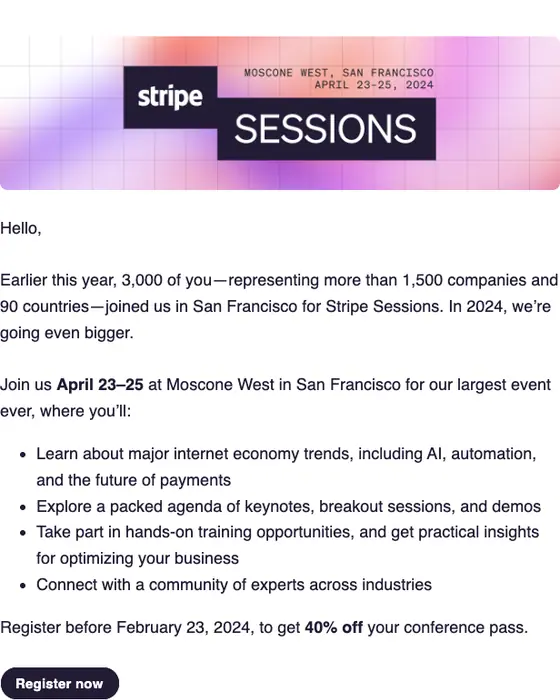
| Invitation or announcement | Every subject line not counted in the three rows below | 368 | Stripe, 2023: "Stripe Sessions is back for 2024" |
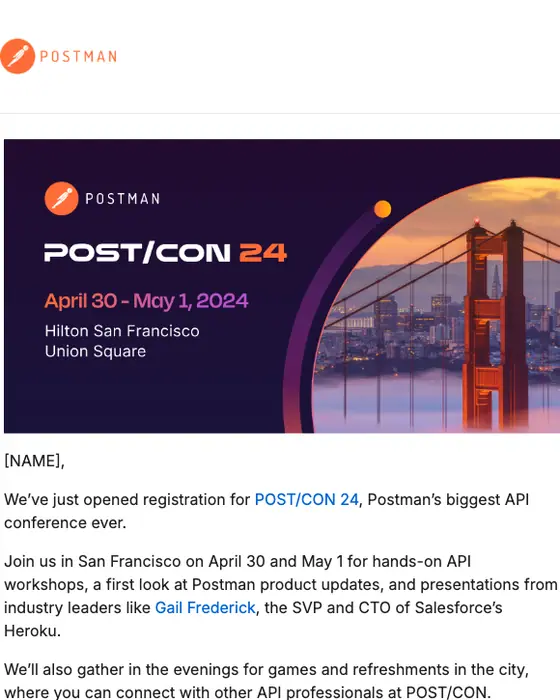
| Ticket release | Subject says tickets, presale, on sale, early bird or registration open | 35 | Postman, 2024: "POST/CON 24 tickets are on sale! Save 50% as an early adopter" |
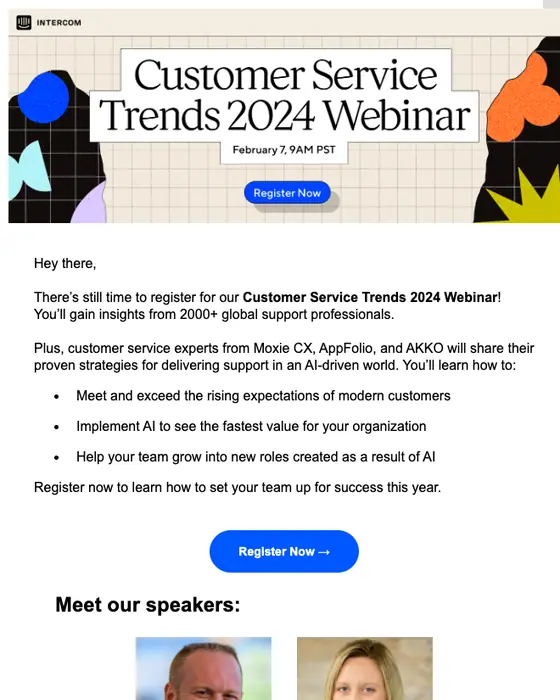
| Reminder or countdown | Subject says last chance, today, tomorrow, this weekend, a number of days to go, or similar | 105 | Intercom, 2024: "Last chance to register: Customer Service Trends 2024" |
| Save the date | Subject says save the date | 6 | Zimmermann, 2025: "Save The Date: Zimmermann Spring 2026 Show" |
Stripe's is signed by its cofounder, opens with how many people came to the last Sessions, puts the dates in bold, and has one Register now button with 40% off for booking early. Intercom's reminder starts "There's still time to register", shows the four speakers with their photos, and repeats the Register Now button under them. Postman's puts the dates and the hotel in the header image and offers 50% off to anyone who registers by a set date. Zimmermann's is one photograph, the show date and time, and three places to watch it live.
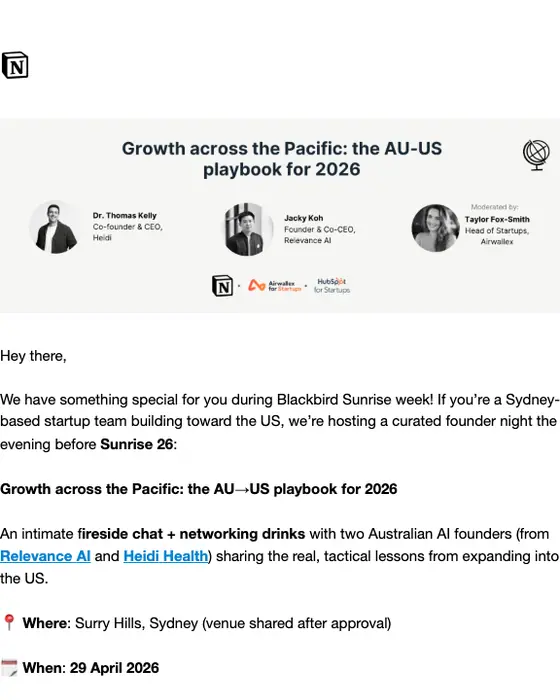
Most of the 514 fall in the first row, an invitation or announcement. Reminders are the next biggest group: 105, of which 67 were sent in 2023 or later. Also here: Notion's founder evening, which asks people to request an invite and shares the venue only after approval.
How event invitations differ from webinar invites and other email
Event invitation emails against webinar emails and every other email
514 event invitation, 211 webinar and 11,986 other emails| What we measured | Event invitation | Webinar | Every other email |
|---|---|---|---|
| Says a form of the word invite in the subject line | 13% | 6% | 1% |
| Subject line reads as a reminder or countdown | 20% | 18% | 8% |
| A weekday, today, tonight, tomorrow or this week in the subject line | 12% | 9% | 6% |
| An emoji in the subject line | 18% | 4% | 15% |
| Urgent tone | 18% | 12% | 12% |
| Sent to a business audience | 46% | 86% | 17% |
| Hero image | 12% | 3% | 12% |
| Plain text layout | 34% | 37% | 31% |
| Exactly one call to action | 31% | 43% | 30% |
| Uses the reader's first name | 38% | 50% | 40% |
| Median calls to action | 2 | 2 | 2 |
They say what they are. 13% put a form of the word invite in the subject line, against 1% of every other email, and 12% name a weekday, today, tonight, tomorrow or this week there. 18% carry an emoji in the subject line, against 4% of webinar emails.
They are less of a business send than webinars are. 46% went to a business audience, against 86% of webinar emails. Plain text is common in both: 34% of event invitations use a plain text layout. The "Every other email" column leaves out both event invitations and webinars.
Next to this one
The same library, cut a different way: webinar emails, emails from events businesses, product launch emails, newsletters and promotional emails.
Questions about event invitation emails
Name the event, the date and the place, then give one way to say yes. In the 514 we collected, 65% use a single column, 34% are plain text, and the median email has two calls to action. Stripe's opens with how many came to the last Sessions, then the dates, the venue and one Register now button.
One that says it is an invitation before it is opened. 13% of the 514 put a form of the word invite in the subject line, against 1% of every other email. Zimmermann's is a single photograph with the show date and time and three places to watch it live.
A short one that tells the reader what to do and when. 43% of the 514 are short and another 6% are shorter still. Half are written in an instructional tone, and 38% use the reader's first name. Postman's names the dates, the hotel and a deadline for half price.
Ask once, then remind sparingly. Going by the subject line, 105 of the 514, 20%, are reminders or countdowns, and 18% are written in an urgent tone. Notion's founder evening asks people to request an invite and says the venue is shared after approval.
337 of the 514 have not been rendered full length for the library yet. Of the 177 that have, we left out 52: 29 repeat sends from brands already in the grid, 9 with broken images or private details, and 14 for other reasons, such as walls of text or emails that are not invitations. The percentages still describe all 514.