
![Netflix digest email: [NAME], what are people watching in your area?](/email-examples/img/19bd559f5351c23a-t.webp)

What a digest email is
A digest email bundles what happened over a set window, a day, a week or a month, into one scheduled message, so the reader gets one email instead of many.
We kept 70 of them from 33 companies, collected from two ordinary inboxes and sent between 2016 and 2026, after taking out the ones that showed personal details or did not render whole. Nothing here is a mockup. This page shows 8 from 6 companies, all sent in 2022 or later. Only 23 digests have been published as images so far, and 13 of the 15 we took off this page showed personal details.
Browse all 8 digest emails
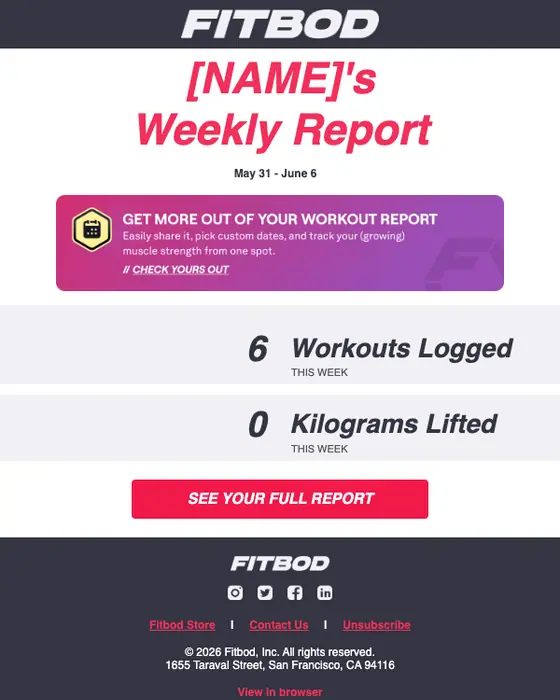
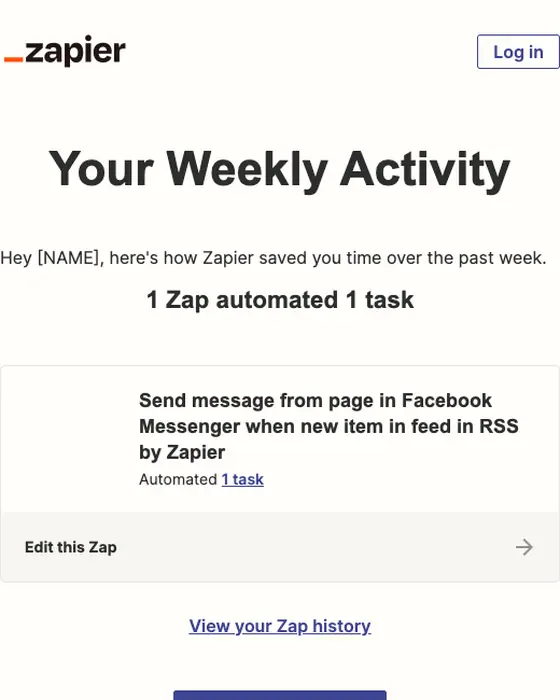
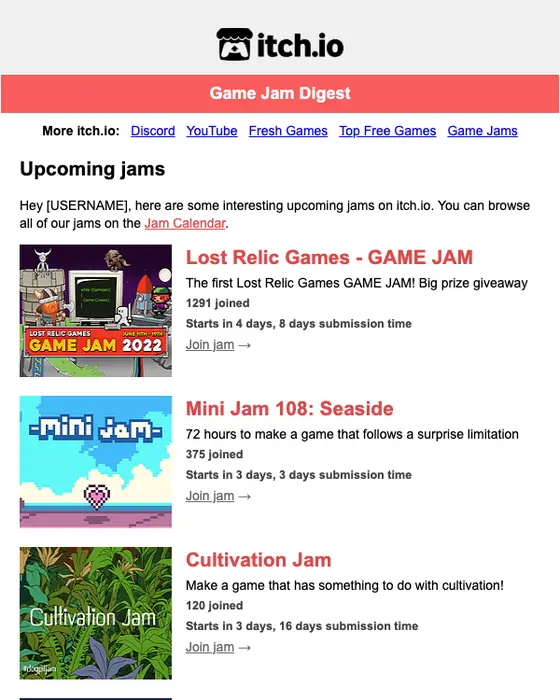
They come in three kinds. Activity summaries report what the reader did: Fitbod counts workouts logged and kilograms lifted, Zapier counts the tasks its automations ran, and Netflix lists the themes a kids profile has been watching. Personalized picks choose items from the reader's interests, like Bandsintown's artists headed your way and AllEvents' event recommendations. Content roundups send everyone the same list, like Netflix's Top 10 in Australia or itch.io's upcoming game jams. Open any email to see it full length, with its subject line, notes on what it is doing, and a prompt that rebuilds it.
Netflix
[NAME], what are people watching in your area?
Fitbod
Your Weekly Workout Report From Fitbod
Bandsintown
🔔 The Voidz, eivør, Float Like A Buffalo shows coming up fast!
Zapier
Your Weekly Task Summary for Jul 16, 2023
itch.io
🏆 Jam Digest: Lost Relic Games Jam, Cultivation Jam, Mini Jam 108: Seaside & more
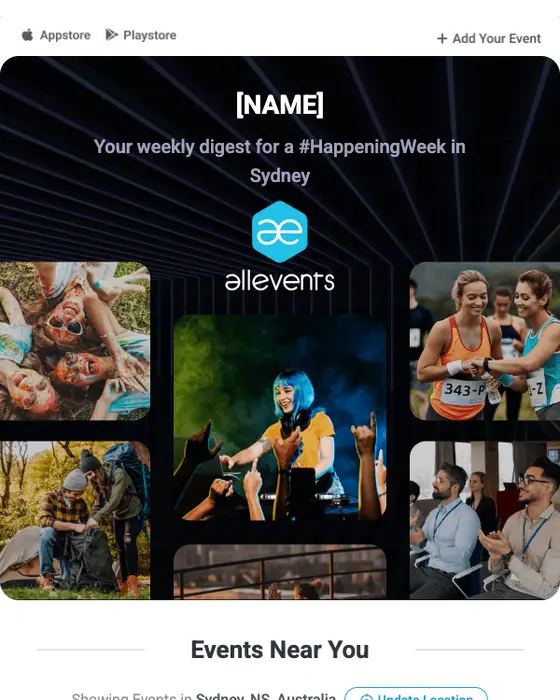
AllEvents.in
[NAME], popular events this weekend in Sydney
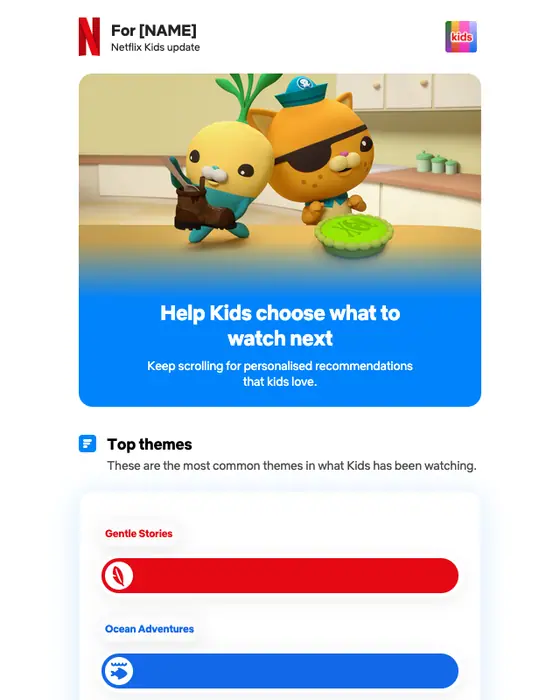
Netflix
Kids update: recap for Kids
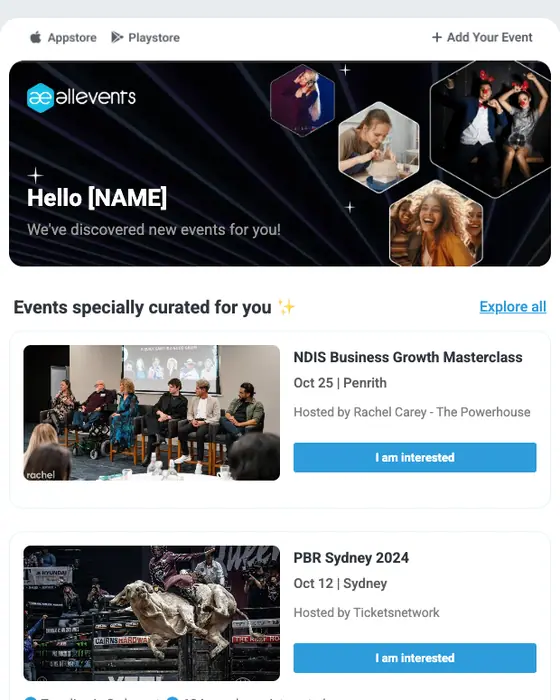
AllEvents
Events for [NAME], new recommendations
How digests differ from newsletters
Digests, newsletters and all email, same two inboxes
70 digests, 1,526 newsletters, 12,288 emails| What we measured | Digest | Newsletter | All email |
|---|---|---|---|
| Six or more calls to action | 47% | 42% | 17% |
| Median calls to action | 5 | 5 | 2 |
| Exactly one call to action | 11% | 15% | 31% |
| Greets by first name | 31% | 24% | 39% |
| Single column layout | 69% | 78% | 64% |
| Long (the top of our four length tags: micro, short, medium, long) | 34% | 47% | 16% |
| Opens on a hero image | 1% | 5% | 12% |
| Sent to existing users (retention) | 99% | 93% | 39% |
Digests pack in links. 47% carry six or more calls to action, the highest share of any kind of email in the library with 20 or more examples: 42% of newsletters, 38% of reservation emails and 17% of all 12,288 emails. The median digest carries 5, the same as a newsletter and against 2 for email overall. They are less often long than newsletters, 34% against 47%, so the links come packed into shorter emails.
Digests greet the reader by first name less often than email overall, 31% against 39%, but more often than newsletters at 24%. 69% are a single column of blocks, fewer than newsletters at 78%, and only 1 of the 70 opens on a hero image, against 12% of all email. Newsletters have their own collection in newsletter email examples.
What is in the collected set
By industry
all 70 digest emails kept| Industry | Emails | Share of the set |
|---|---|---|
| Media publishing | 30 emails | 43% of the set |
| SaaS | 19 emails | 27% of the set |
| Professional services | 7 emails | 10% of the set |
| Entertainment | 3 emails | 4% of the set |
| Education | 3 emails | 4% of the set |
| Marketplace | 2 emails | 3% of the set |
| Events | 2 emails | 3% of the set |
| Fintech, gaming, health and fitness, other (one each) | 4 emails | 6% of the set |
Media publishing and SaaS sent 49 of the 70 between them. The set runs from 2016 to 2026, and its biggest years are 2019 with 18 and 2025 with 15. 29 of the 70 (41%) were sent in 2023 or later. Of the 8 in the grid, 3 are activity summaries, 3 are personalized picks and 2 are content roundups sent to everyone.
What makes one worth sending
Nitrosend sends its own users a daily digest email, a weekly and a monthly, each timed for 9am in the reader's time zone when the account has one set. Four rules came out of running them.
Skip the empty window. The daily skipped a day with no activity from the start. The weekly did not at first, and a weekly full of zeros went out, so the weekly and monthly now skip an account with no sends and no new subscribers in the window.
Count new subscribers as activity. Nitrosend's digests first paused on accounts with no recent sends, which silenced accounts collecting subscribers before their first send. They now come back on either.
Compare like with like. The weekly reports change against the week before and the monthly against the month before, and the two weekly windows are each seven complete days ending the day before the send, so both numbers cover the same span.
Send one a day at most. When two fall on the same day the longer window wins: monthly over weekly, weekly over daily.
Next to this one
The same library, cut by who gets the email and why: job alerts, another scheduled list of picks, re-engagement emails for readers who went quiet, and retention emails across every type. By industry, the two that send the most digests: media and publishing and SaaS.
Questions about digest emails
A digest email bundles what happened over a set window into one scheduled message: the reader's own activity, items picked for them, or a roundup sent to everyone. Of the 70 we kept, 69 are retention emails, sent to people who already use the product, and 47% carry six or more calls to action, against 17% of email overall.
A newsletter is written for its readers each issue. A digest is assembled from whatever the window held. In the same two inboxes, digests more often carry six or more calls to action (47% against 42%), are less often long (34% against 47%) and greet the reader by first name more often (31% against 24%).
Media and publishing brands, then software. Of the 70 digest emails we kept, 30 (43%) came from media publishing, 19 (27%) from SaaS products and 7 (10%) from professional services. Entertainment, education, marketplaces and events sent the rest, along with four industries that sent one each.
No. Nitrosend's own weekly and monthly digests now skip any account with no sends and no new subscribers in the window, the way the daily always did. Count new subscribers as activity too, or you go quiet on accounts that are growing before their first send.
When a subject line names a cadence, it is weekly: 6 of the 70 subject lines say weekly, none say daily or monthly. That is a small sample, so read it as a hint. Nitrosend sends a daily digest email, a weekly and a monthly, at most one per person per day, and the longer window wins: monthly over weekly, weekly over daily.
Only 23 digests had been published as images here, and we took 15 of those off this page. Thirteen showed personal details: a reader's name or profile photo, the faces of friends who upvoted a product, other people's names and posts, a private league name or a reader's suburb. One was cut off at the right edge and one repeated a Zapier template.