
![Alamo Rent A Car booking confirmation email: Alamo Rent A Car Reservation Confirmation [ORDER_NO] at MELBOURNE AIRPORT (MEL)](/email-examples/img/1956f979bf731428-t.webp)
![Pilu At Freshwater reservation email: Update: Your Reservation at Pilu At Freshwater | [NAME] on 15/06/2024](/email-examples/img/18fd31f84bc42745-t.webp)
![Budget Car & Truck Rental reservation email: Budget Car & Truck Rental: Reservation Reminder | [NAME] | Pick-up date:9/4/2024](/email-examples/img/18eb7330e7417c55-t.webp)
What a reservation email is
A reservation email is a message a business sends about a table, a car, a room or a place you have reserved: the confirmation, the reminder before the day, and the notice when something changes.
We collected 82 from 15 senders in two real inboxes, sent between 2023 and 2026, and show 6 emails here: 4 of the 82, plus 2 from our booking confirmation emails. The other 78 are not shown, because 5 print personal details and 73 have not been rendered for the email example library. The percentages below describe all 82.
Browse all 6 emails
A restaurant booking reminder, a reservation update from a second restaurant, a car rental check-in, a car rental reminder, a confirmation for a reserved product and a plain-text nudge to book a dinner. Filter by industry or search a brand or subject line. Open any email to see it full length, with its subject line, notes on what it is doing, and a prompt that rebuilds it.
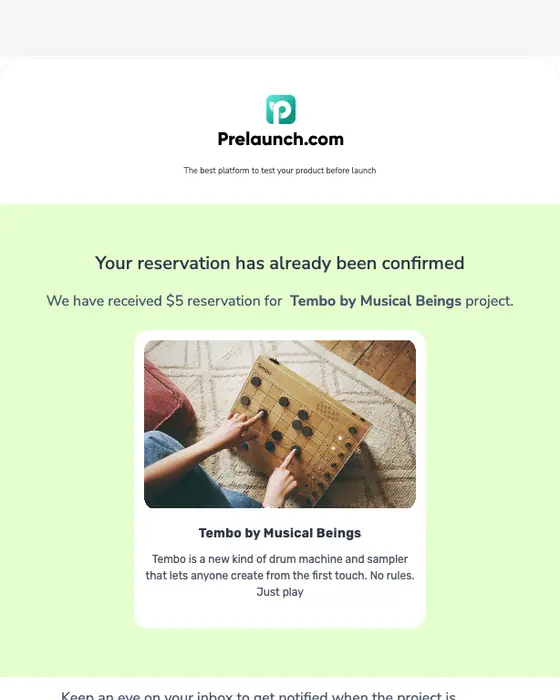
Prelaunch.com
Your reservation for "Tembo by Musical Beings" project is confirmed
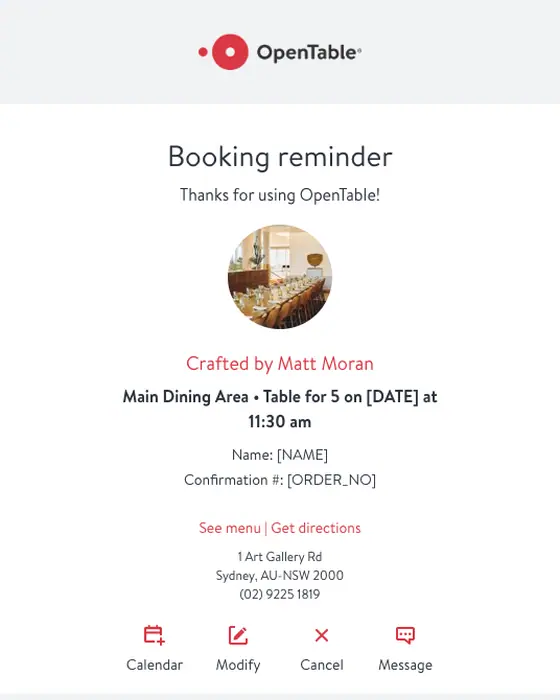
OpenTable | Crafted by Matt Moran Bookings
Your upcoming booking at Crafted by Matt Moran
Alamo Rent A Car
Alamo Rent A Car Reservation Confirmation [ORDER_NO] at MELBOURNE AIRPORT (MEL)
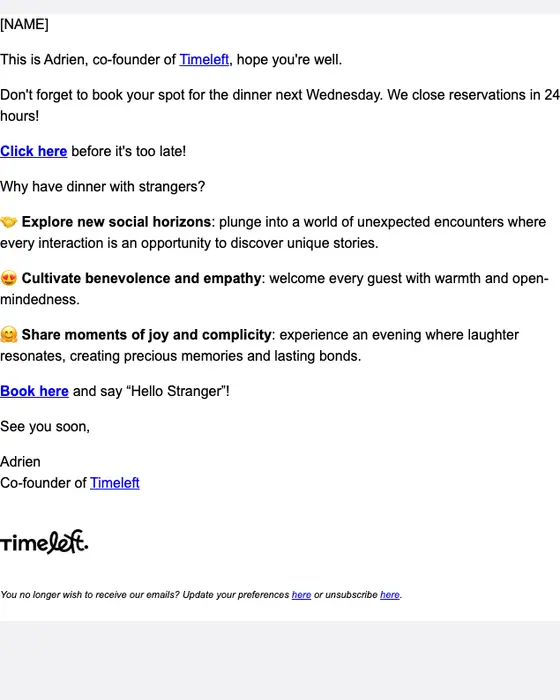
Timeleft
Reservations close in 24 hours ⌛
Pilu At Freshwater
Update: Your Reservation at Pilu At Freshwater | [NAME] on 15/06/2024
Budget Car & Truck Rental
Budget Car & Truck Rental: Reservation Reminder | [NAME] | Pick-up date:9/4/2024
How reservation emails differ from booking confirmations and everything else
Reservation emails against booking confirmations and every other email
82 reservation, 306 booking confirmation and 12,629 other emails| What we measured | Reservation | Booking confirmation | Every other email |
|---|---|---|---|
| Subject line uses the word "reservation" | 99% | 15% | 1% |
| Plain subject line that says what it is | 70% | 94% | 32% |
| Greets the reader by first name | 57% | 60% | 40% |
| Instructional tone | 57% | 52% | 37% |
| Long email | 35% | 28% | 16% |
| Plain-text layout | 33% | 45% | 32% |
| Exactly one link or button | 18% | 15% | 30% |
| Sent by a travel or hospitality business | 93% | 64% | 5% |
| Hero image | 0% | 1% | 12% |
Few reservation emails say in the subject line that they confirm anything. Only 3 of the 82 confirm a reservation or send the itinerary, 37 remind the reader that one is coming up and 27 are replies in a message thread about one. They run longer than other email: 35% are long against 16%, and 18% have exactly one link or button against 30%. None of the 82 uses a hero image.
A reader opens a reservation email to check a date, a time or a rule, so it is read for the detail it carries. Most of this set uses that attention for the detail alone: 70% of the 82 have a plain subject line that says what the email is, and none has a hero image.
Read the reservation column with one caveat. 62 of the 82 came from a single home-rental marketplace. Among the 20 from the other 14 senders, 17 have a plain subject line and 14 greet the reader by first name. The "Every other email" column includes the booking confirmations.
What the 82 collected are
What the subject line says the email is
all 82 collected, read from the subject line| The subject line | Emails | Share |
|---|---|---|
| Reminds the reader a reservation is coming up | 37 | 45% |
| Is a reply in a message thread about a reservation | 27 | 33% |
| Is about a request: a pending reservation request, a reminder to answer one, or a special request | 7 | 9% |
| Says the reservation changed, or that someone wants to change it | 5 | 6% |
| Confirms the reservation or sends the itinerary | 3 | 4% |
| Names the reservation and nothing else | 3 | 4% |
20 of the 37 reminders tell a host that a guest is coming soon. All 20 came from the home-rental marketplace that sent 62 of the 82.
Who sent them
all 82 collected, by industry| Industry | Emails | Share |
|---|---|---|
| Travel | 58 | 71% |
| Hospitality | 18 | 22% |
| Health and fitness | 5 | 6% |
| SaaS | 1 | 1% |
55 of the 58 travel emails are that one sender's, and so are 7 of the 18 hospitality emails. The 5 health and fitness emails are class reservations.
The 6 emails on this page
what each one is, newest first| Sender | What it is | Year |
|---|---|---|
| Prelaunch.com | Confirms a $5 reservation for a product that has not launched | 2026 |
| OpenTable, for Crafted by Matt Moran | Booking reminder: the table, the time and a confirmation number, then the restaurant's terms | 2025 |
| Alamo Rent A Car | Asks the renter to check in before pick-up at Melbourne Airport | 2025 |
| Timeleft | Plain-text nudge: reservations for next Wednesday's dinner close in 24 hours | 2025 |
| Pilu At Freshwater | Update to a dinner reservation, followed by the venue's policies | 2024 |
| Budget Car & Truck Rental | Reminder before pick-up that prints the full reservation terms | 2024 |
Next to this one
The same library, cut by the job the email does: booking confirmation examples, appointment emails, order reminder emails and cancellation emails. By who sends them: travel and hospitality.
Questions about reservation emails
Prelaunch.com's, from 2026, says "Your reservation has already been confirmed", names the product and the $5 received, and tells the reader to watch their inbox for the launch. Only 3 of the 82 reservation emails we collected confirm a reservation or send the itinerary in the subject line. Confirmations have their own page: booking confirmation email examples.
The time, the place, how to change it and the rules. OpenTable's 2025 reminder for Crafted by Matt Moran gives the party size, date and time, a confirmation number, the address and phone number, links to modify or cancel, and the restaurant's cancellation charge. 37 of the 82 we collected are reminders. Our templates for reminder emails go further.
This page holds what businesses send. A guest's request needs the date, time, party size, name and a contact. A business's email puts the date, time and party size first, then how to change or cancel, as Pilu At Freshwater's 2024 update does before its policies. 57% of the 82 we collected greet the reader by first name.
Mostly the word the sender uses and when the email arrives. 99% of the 82 reservation emails we collected use the word reservation in the subject line, against 15% of the 306 booking confirmations. By subject line, 37 of the 82 are reminders, 5 are about a change and only 3 confirm one or send the itinerary.
Only 9 of the 82 have been rendered full length. We took 5 off because they print personal details: a host's phone number and a stay's address in one, the recipient's invite link in four. The other 73 count in the percentages but are not shown. 2 of the 6 shown are booking confirmations, so 4 are among the 82.