
What a tracking email is
A tracking email tells a customer where their parcel is, names the carrier and links to a live tracking page, usually with the tracking number.
This page is one slice of the Nitrosend email library. We collected 40 tracking emails from two ordinary inboxes and removed 9 because they showed personal data. That leaves 31 from 6 senders, and 26 of them are Australia Post notices. So the grid shows 8: 2 of those tracking emails, plus 6 shipping and delivery emails from the same inboxes whose main button opens the tracking page. Each card says which type it is. Nothing here is a mockup.
Tracking emails you can look at
Filter by type. Open any one to read the subject line, what it is doing, and the prompt that rebuilds it.
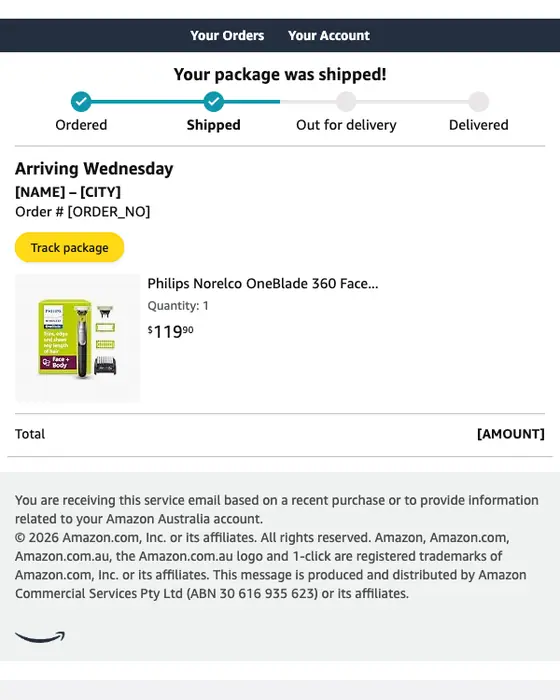
Amazon.com.au
Shipped: ‘Philips Norelco OneBlade...’
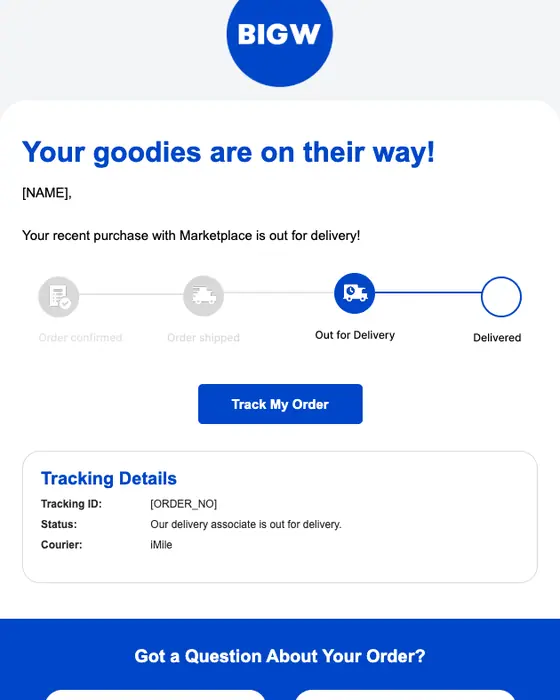
BIG W
Your Marketplace order is out for delivery
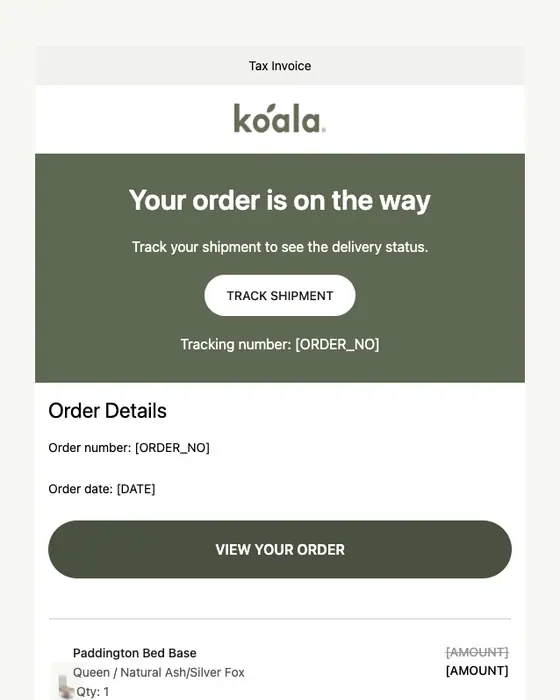
Koala AU
A shipment from order [REF] is on the way
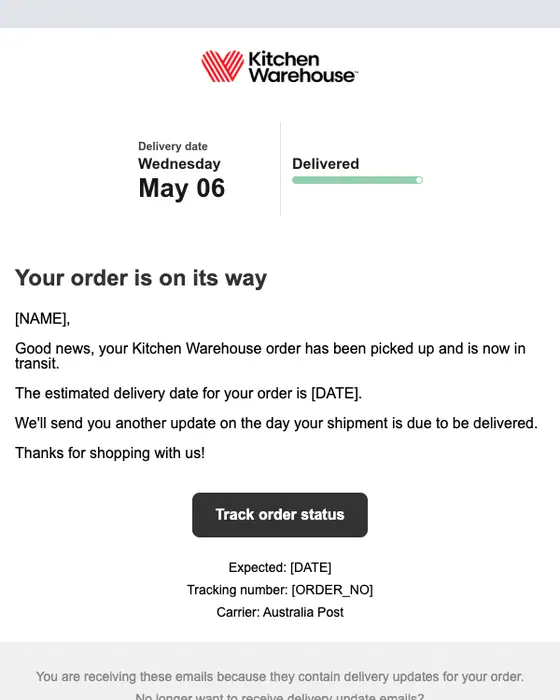
Kitchen Warehouse
Your Kitchen Warehouse order [REF] is on its way
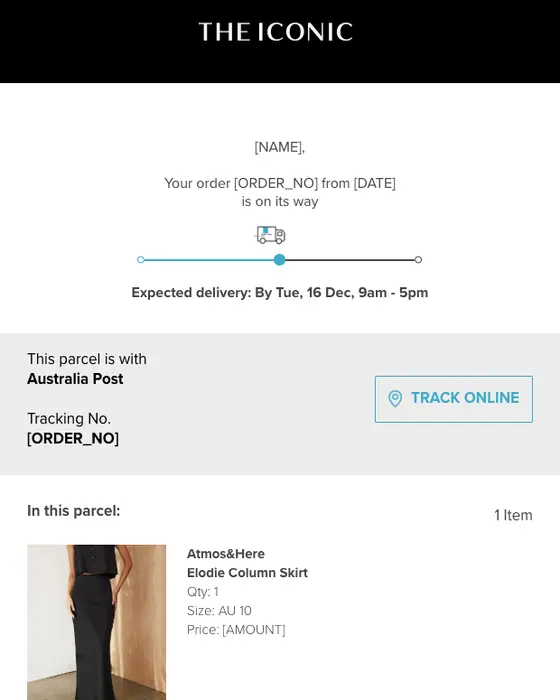
THE ICONIC
Good news [NAME], your order is on its way!
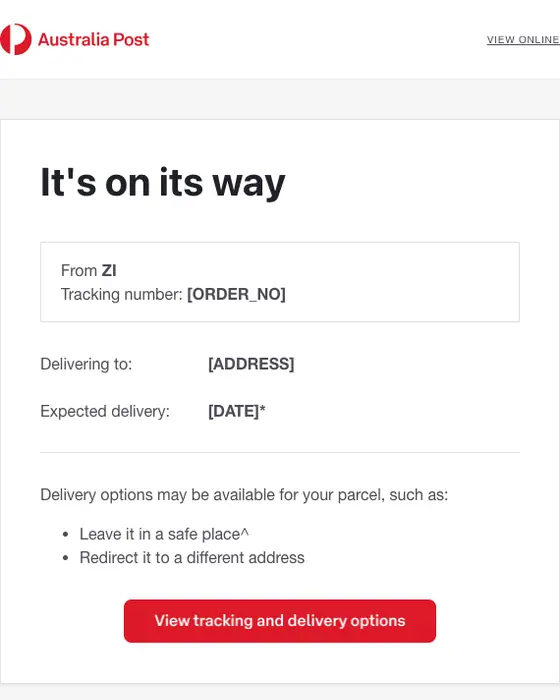
Australia Post
Your parcel from ZI is on its way
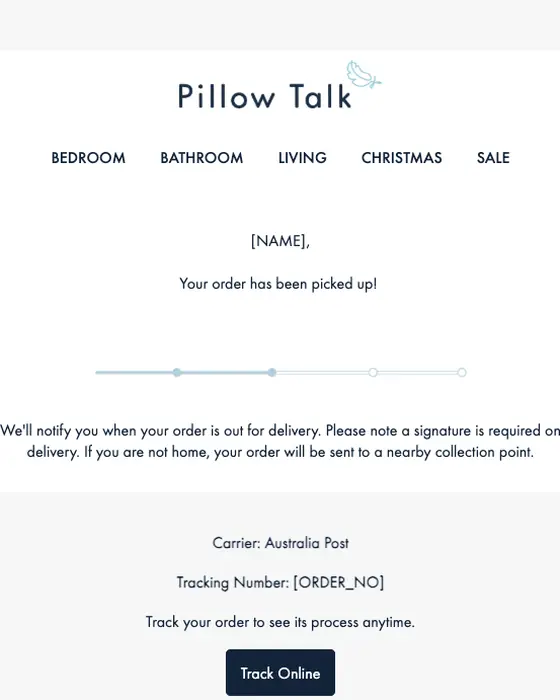
Pillow Talk
Your Pillow Talk order is on its way to you
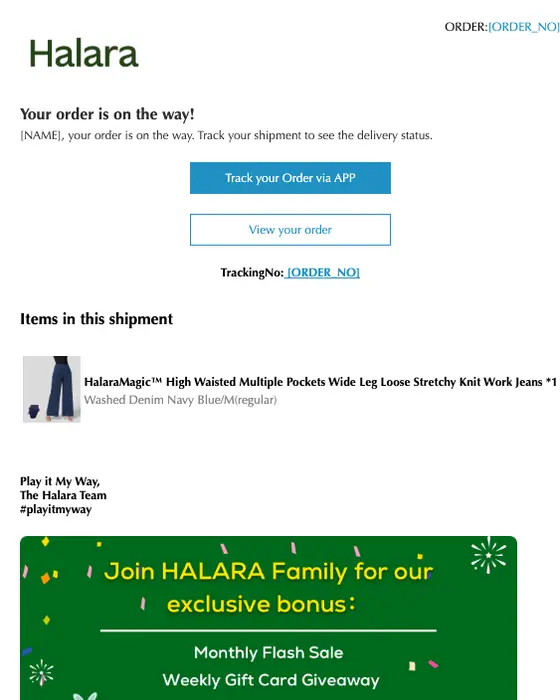
Halara
Your Halara Order is on its way!
How tracking compares with shipping and delivery emails
Most senders never send a separate tracking email: only 3 of the 239 shipping senders also appear among the tracking senders. In the same two inboxes, shipping confirmations outnumber tracking emails 693 to 31, and come from 239 senders against 6. 407 of the 693 shipping confirmations (59%) have a tracking button as the main call to action. The standalone tracking notice is mostly the carrier's own, which is why 84% of this set is Australia Post.
Tracking next to the emails around it
Same two inboxes| Measure | Tracking | Shipping | Delivery | Order confirmation |
|---|---|---|---|---|
| Emails collected | 31 | 693 | 311 | 391 |
| Different senders | 6 | 239 | 64 | 298 |
| Sent by Australia Post | 84% | 13% | 33% | 0% |
| Utilitarian design | 90% | 54% | 59% | 54% |
| Single column | 81% | 71% | 80% | 70% |
| Greet the customer by first name | 10% | 36% | 24% | 68% |
| Exactly one call to action (as tagged) | 39% | 37% | 16% | 20% |
| Median calls to action (as tagged) | 3 | 2 | 2 | 2 |
Australia Post's notices set the tracking column: 90% utilitarian, 10% use a first name, a median of 3 calls to action as tagged. Order confirmations sit at the other end, with 68% using the customer's first name. The retail cards in the grid show what a brand adds when it sends its own update: a progress bar (Amazon.com.au, BIG W, THE ICONIC), the carrier and tracking number in one block (Pillow Talk, BIG W, THE ICONIC), and the items in the parcel.
None of this helps if the send never lands, which is a transactional email problem rather than a design one. One practical guard is to send transactional mail, parcel updates included, from its own subdomain (for example txn.yourdomain.com, with promotions on news.yourdomain.com), so a large promotional send cannot drag down the delivery of receipts and password resets. It matters most for large-volume senders; most brands are fine with a single subdomain, according to the Nitrosend sending domains guide.
What is in this set
The tracking emails by industry
31 emails from 6 senders| Industry | Emails | Share |
|---|---|---|
| Logistics | 27 emails | 87% |
| Ecommerce | 4 emails | 13% |
The grid adds 5 shipping and 1 delivery emails. They are not counted in the tracking column above; they are counted in their own columns.
Next to this one
The same inboxes, one step either side of tracking: shipping, delivery, order confirmation, order reminder.
Questions people ask
Look at what the retailers in the grid do: the carrier and tracking number in one block, a button to the live status page, and the items in the parcel. Amazon.com.au, BIG W and THE ICONIC add a progress bar. Only 10% of the 31 tracking emails we kept greet the customer by first name.
Usually it is the same email. In our two inboxes, shipping confirmations outnumber standalone tracking emails 693 to 31, because the shipping confirmation usually carries the tracking link: 407 of the 693 shipping confirmations have a tracking button as the main action. The separate tracking email is mostly the carrier's own notice: 26 of the 31 we kept come from Australia Post.
We collected 40 and removed 9 for personal data, such as delivery addresses, live tracking numbers, a coupon code and other orders on the account. Of the 31 left, 26 are Australia Post notices, so we show one of those and fill the grid with shipping and delivery emails whose main button is a tracking link.