
![Kitchen Warehouse delivery email: Your order [REF] has been delivered](/email-examples/img/19dfbcf55dc86320-t.webp)
![Openhagen delivery email: Openhagen Order [REF] Delivery Check](/email-examples/img/19b8f2615cd6829d-t.webp)
What a delivery email is
A delivery email (also called a delivery confirmation or delivery notification email) is the message a shop or carrier sends after an order has left the warehouse: that it is on its way, that it is out for delivery today, or that it has been delivered.
We collected 346 from 78 senders in two real inboxes, sent between 2019 and 2026, and show 14 of them here. The percentages describe all 346. 29 had been rendered for the library, and we took 15 of those off this page: 11 because they print a person's details, such as the recipient's ZIP code or a private seller's username, or a live tracking number, 2 because their images did not load, and 2 because they repeat a template already shown. The inboxes are Australian, so 61% of the 346 are from Australian senders and only 19 from American ones.
Browse all 14 delivery emails
Out-for-delivery notices, delivered confirmations and a check-in that asks whether the parcel arrived, from homewares, fashion, marketplace and food senders. Filter by tone or search a brand or subject line. Open any email to see it full length, with its subject line, notes on what it is doing, and a prompt that rebuilds it.
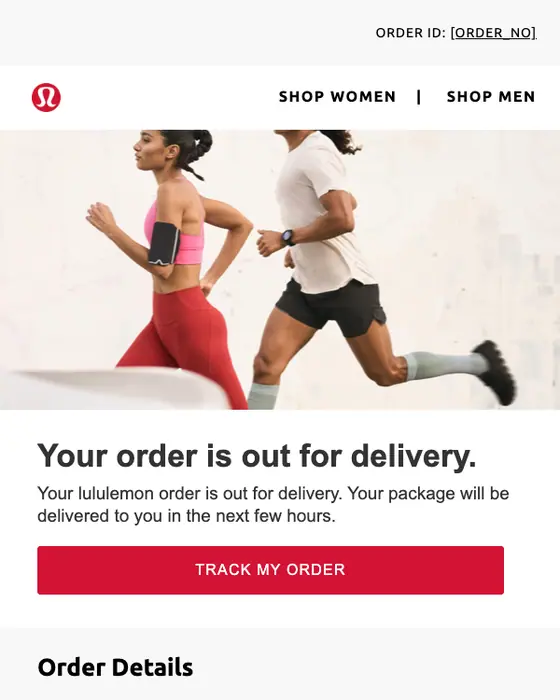
lululemon
Your order is out for delivery.
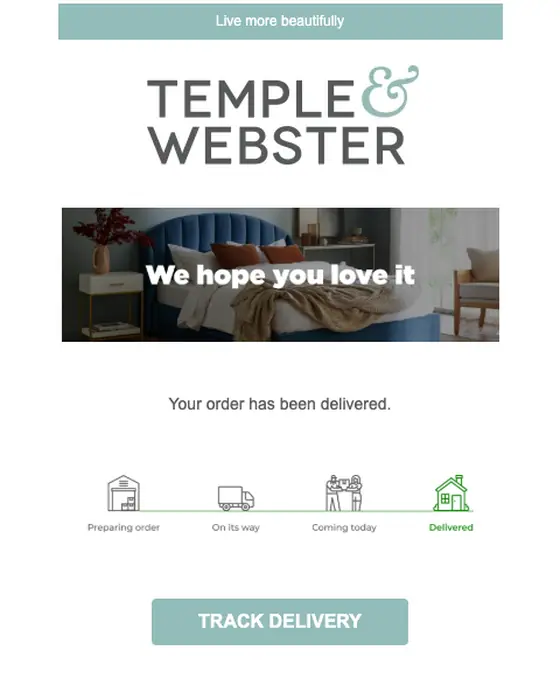
Temple & Webster
Order delivered
Kitchen Warehouse
Your order [REF] has been delivered
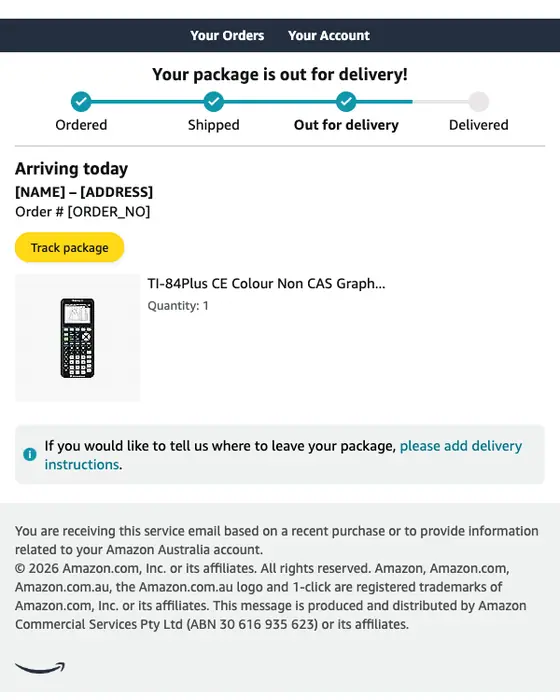
Amazon.com.au
Out for delivery: ‘TI-84Plus CE Colour Non CAS...’
Openhagen
Openhagen Order [REF] Delivery Check
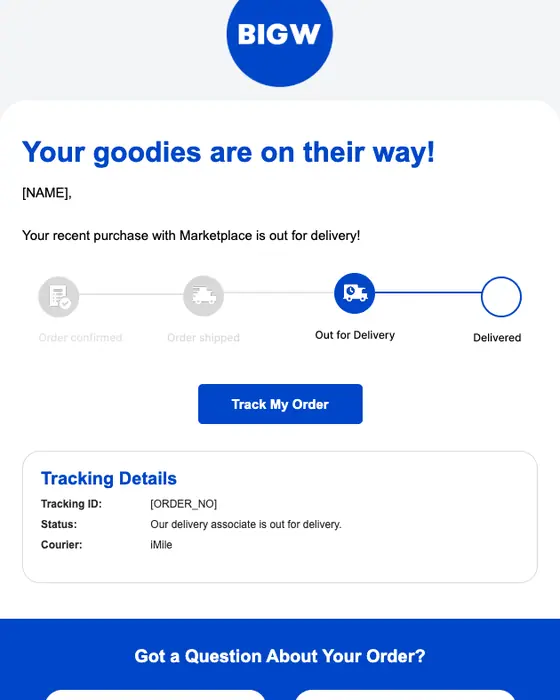
BIG W
Your Marketplace order is out for delivery
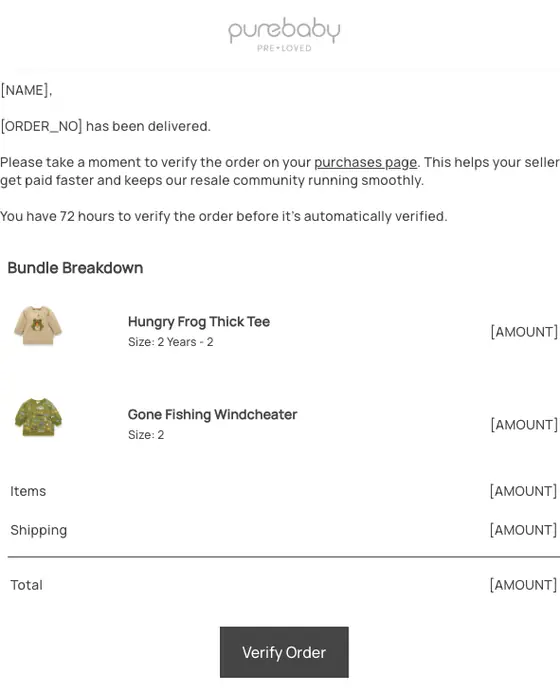
Purebaby Pre-Loved
Your Order Has Been Delivered
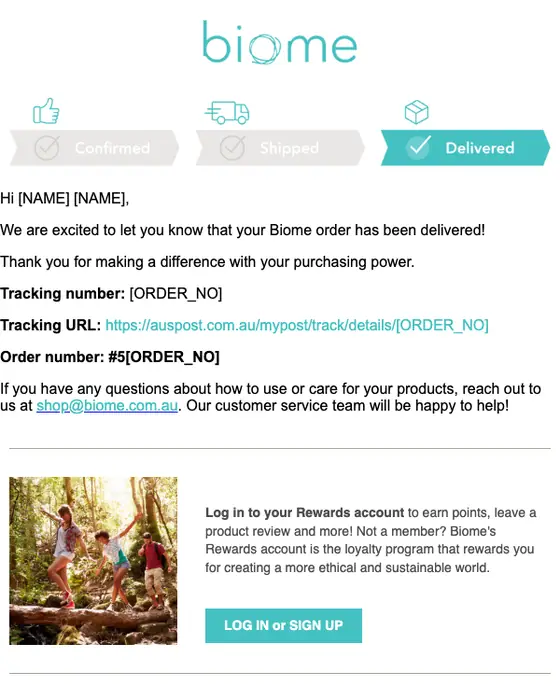
Biome Eco Stores
Your Biome Order Has Been Delivered!
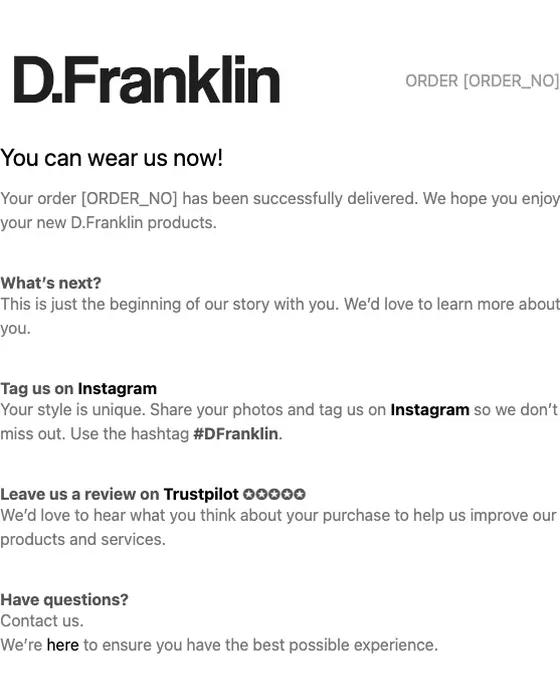
D.Franklin
Your order from D.Franklin has been delivered!
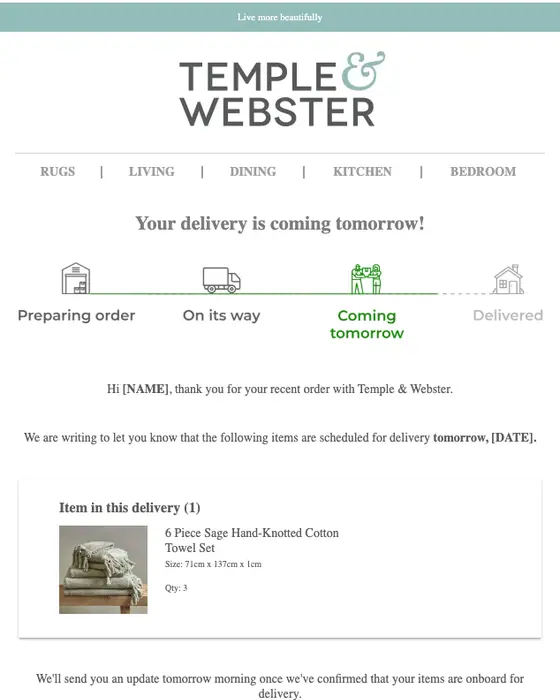
Temple & Webster
Your Temple & Webster Order [ORDER_NO] is Scheduled for Delivery!
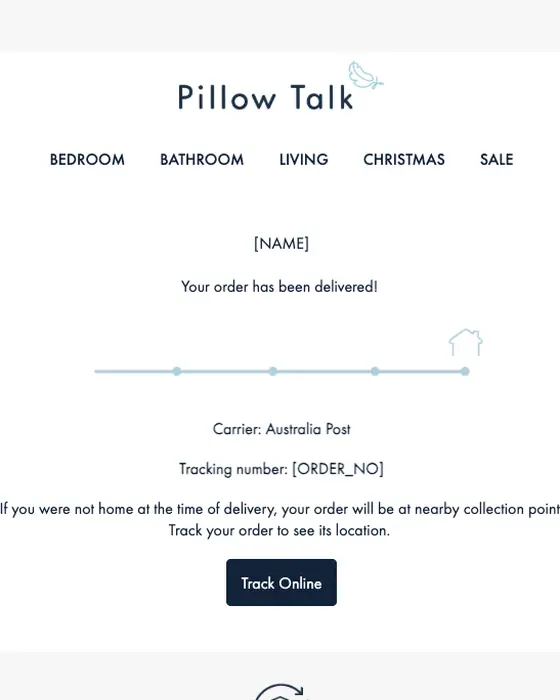
Pillow Talk
Your Pillow Talk order has been delivered - enjoy!
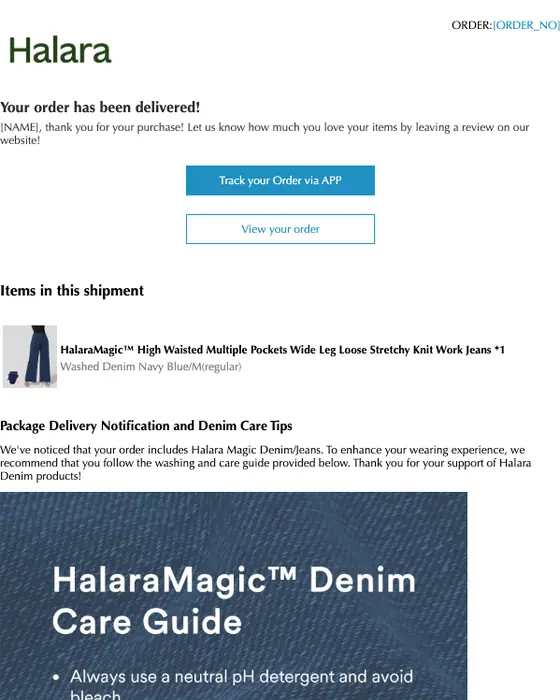
Halara
Your order has been delivered!
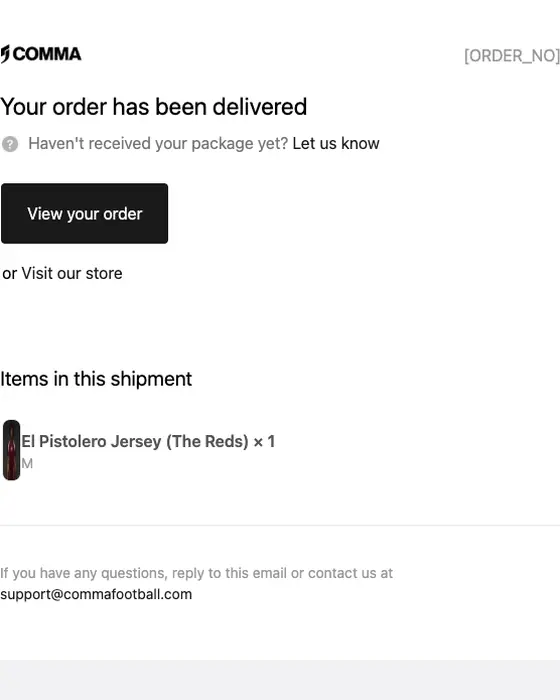
Comma Football
A shipment from order [REF] has been delivered
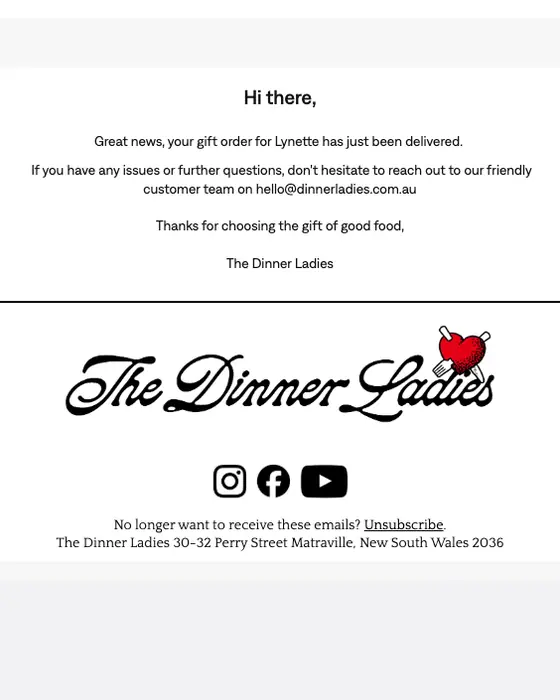
The Dinner Ladies
Your Dinner Ladies Gift has been delivered!
What goes in one, shown by the emails above
- The order in the subject line. Temple & Webster's 2023 notice puts the brand name and the order number in the subject, then says it is scheduled for delivery.
- The carrier and the tracking number. Pillow Talk's 2025 email names the carrier and prints the tracking number above a Track Online button. BIG W's 2026 Marketplace notice names the courier, iMile.
- When it will turn up. lululemon's 2024 email says the package will arrive "in the next few hours". Temple & Webster's 2023 one says tomorrow and promises another update that morning.
- What is in the box. lululemon lists all three items with size and color, under the order ID, order date and tracking number.
- What to do if something is wrong. Kitchen Warehouse's 2026 email says some orders come in more than one package, then asks you to rate the delivery. Openhagen's 2026 plain-text check-in asks you to reply if anything is off.
One sending rule follows from what these emails say. "Out for delivery today" and "in the next few hours" are true only on the day they are sent, so a delivery notice that fails to send is better dropped than retried a day or more later, unless the retry falls inside a short recovery window. A late out-for-delivery email lands after the parcel, or after the delivered notice it should have come before.
How delivery emails differ from shipping and order confirmations
Delivery emails against shipping emails, order confirmations and every other email
346 delivery, 752 shipping, 471 order confirmation and 12,365 other emails| What we measured | Delivery | Shipping | Order confirmation | Every other email |
|---|---|---|---|---|
| Subject line mentions delivery, arrival or "on its way" | 99% | 21% | 1% | 2% |
| Plain subject line that says what it is | 98% | 97% | 96% | 31% |
| Exactly one link or button | 16% | 36% | 20% | 30% |
| Greets the reader by first name | 29% | 39% | 70% | 41% |
| Single-column layout | 82% | 73% | 72% | 65% |
| Monochrome color | 82% | 82% | 72% | 61% |
| A table of the order (items, prices, totals) | 4% | 6% | 30% | 3% |
| Hero image | 1% | 2% | 1% | 12% |
| Sent by an Australian business | 61% | 70% | 84% | 48% |
An order confirmation says what you bought, so 30% carry a table of items and prices. A delivery email says where the parcel is: 99% of the 346 mention delivery, arrival or "on its way" in the subject line, against 21% of shipping emails. Only 4% repeat the order table and 1% use a hero image. The median delivery email has 2 links or buttons.
The "Every other email" column includes the shipping emails and order confirmations.
What the 346 collected are
What the subject line says
all 346 collected, read from the subject line| The subject line | Emails | Share |
|---|---|---|
| Says it has been delivered or has arrived | 214 | 62% |
| Says it is on its way, shipped or scheduled | 81 | 23% |
| Says it is out for delivery or arriving today | 39 | 11% |
| Says something else, such as ready to collect | 12 | 3% |
Who sent them
all 346 collected, by industry| Industry | Emails | Share |
|---|---|---|
| Logistics and carriers | 114 | 33% |
| Marketplaces | 106 | 31% |
| Online shops | 101 | 29% |
| Other industries | 25 | 7% |
Two senders account for 196 of the 346: Australia's national postal carrier sent 103 and a resale marketplace sent 93, which are all of the 93 from the UK. None of their emails are shown here. The carrier's emails that were rendered print the recipient's ZIP code, and the marketplace's emails name a private seller or buyer by username.
Next to this one
The steps before delivery have their own pages: order confirmation emails, shipping emails and tracking emails. The whole stretch from purchase to doorstep is fulfillment emails, and most senders here are ecommerce or logistics businesses.
Questions about delivery emails
It tells the customer the order has arrived. 214 of the 346 we collected (62%) say in the subject line that it has been delivered or has arrived. Kitchen Warehouse's 2026 email says the order has been delivered, warns that some orders come in more than one package, and gives the tracking number, the carrier and a short delivery rating.
The order number, the carrier and tracking number, when it will arrive, what is in the parcel and where to get help. lululemon's 2024 out-for-delivery email has the order ID, the tracking number, a few-hours arrival window, every item with size and color, and a live chat link. Keep the subject plain: 98% of the 346 say exactly what the email is.
Ask once, after the delivered date. Openhagen's 2026 plain-text email gives the delivered date, carrier and tracking link, then asks the customer to reply if anything is off. Purebaby Pre-Loved gives the buyer 72 hours to verify the order before it is verified automatically.
The median in the 346 we collected is 2. 16% have exactly one, against 36% of shipping emails. Temple & Webster's 2025 delivered email has Track delivery and Write a review.
29 have been rendered full length for the library so far. We took 11 off because they print a person's details, such as the recipient's ZIP code or a private seller's username, or a live tracking number, 2 because their images did not load, and 2 because they repeat a template already shown. The other 317 are counted in the percentages but not shown.