
![Koala AU shipping email: A shipment from order [REF] is on the way](/email-examples/img/19b7a5518d0d67e6-t.webp)
What a shipping confirmation email is
A shipping confirmation email is the transactional email a store sends when an order leaves the warehouse. It says the parcel is on its way and links to the carrier's tracking. The emails here also include the note just before dispatch and the "arrives today" update. Most skip the customer's name: 39% of the 752 we collected greet the reader by first name, against 70% of order confirmations from the same inboxes.
We collected 752 from 264 brands out of two ordinary inboxes, sent 2018 to 2026, and show 19 from 18 brands here.
Browse all 19 shipping emails
Tap an industry to narrow the grid. Open any email to see it full length, with its subject line, notes on what it is doing, and a prompt that rebuilds it. Want a template? Copy the prompt from any email to rebuild it for your store.
Koala AU
A shipment from order [REF] is on the way
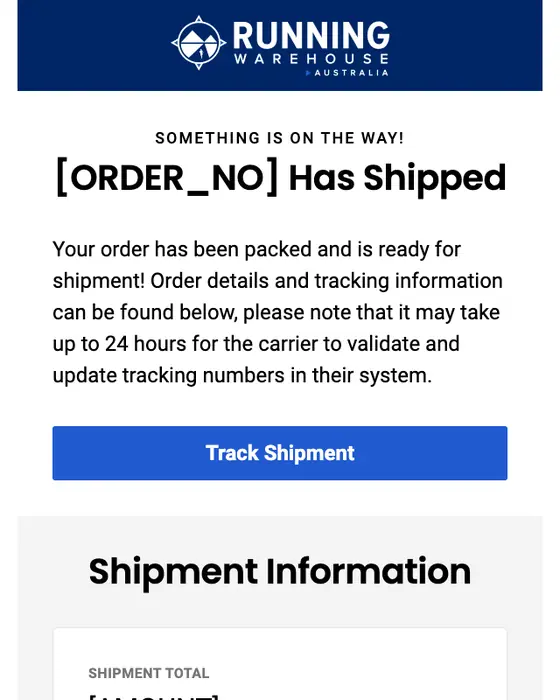
Running Warehouse Australia
Your Running Warehouse Australia order has shipped.
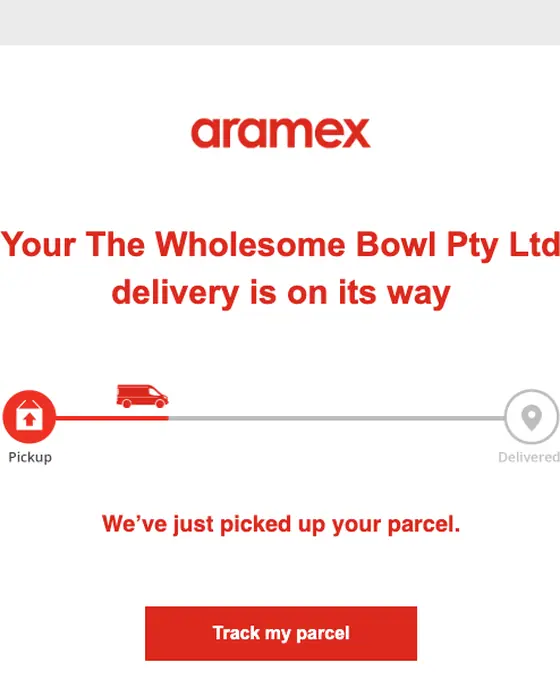
Aramex
Your parcel is on its way
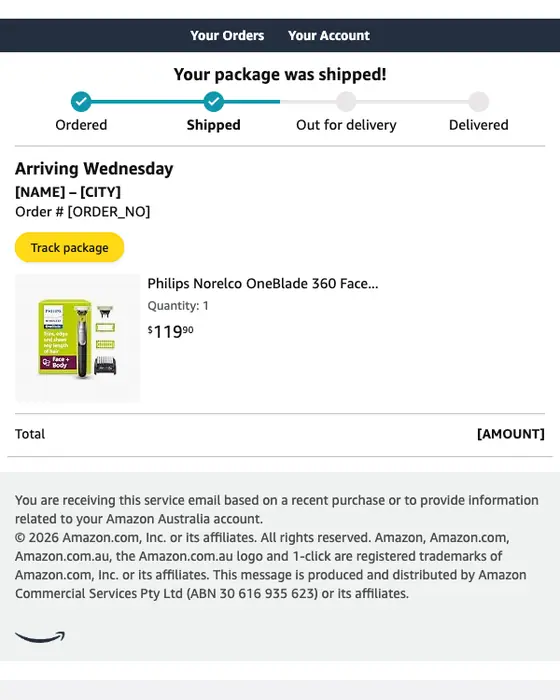
Amazon.com.au
Shipped: ‘Philips Norelco OneBlade...’
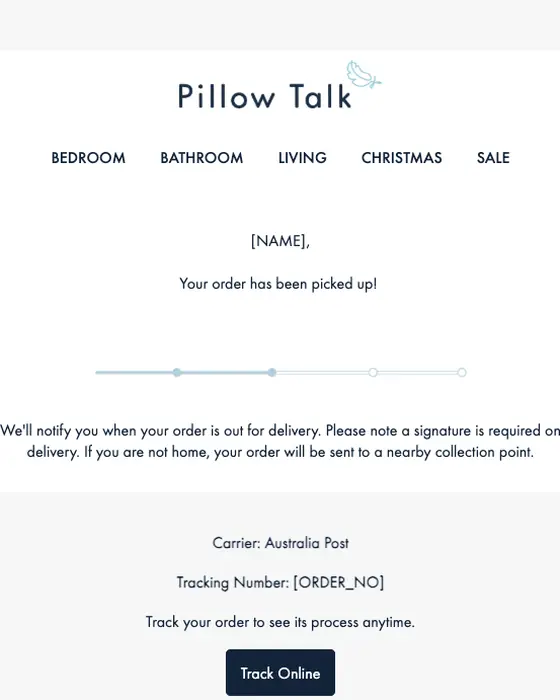
Pillow Talk
Your Pillow Talk order is on its way to you
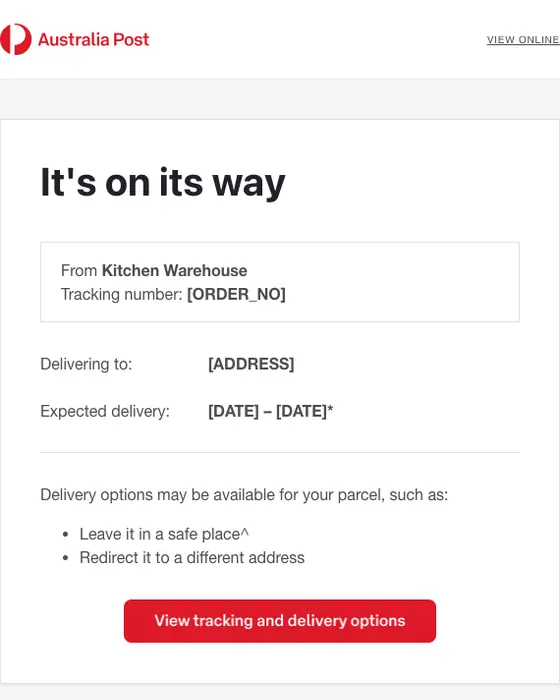
Australia Post
Your parcel from Kitchen Warehouse is on its way
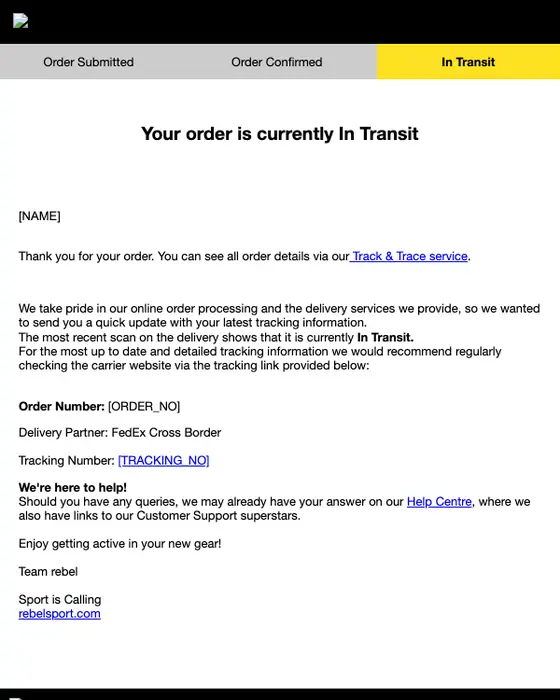
rebel Sport
Your rebel Order is In Transit
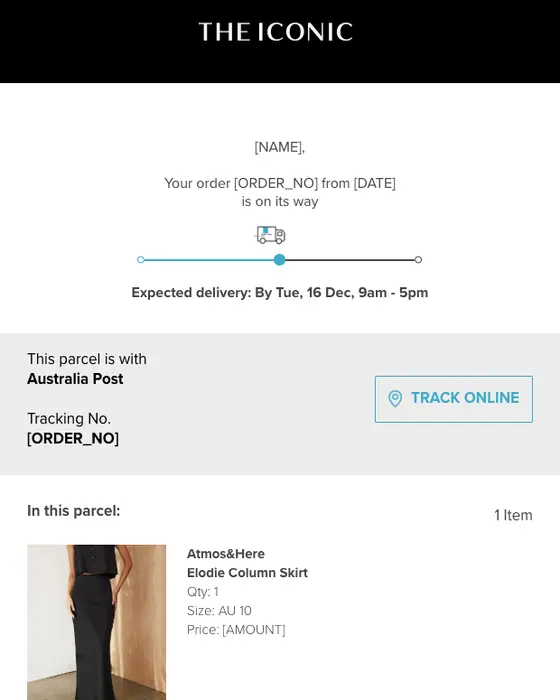
THE ICONIC
Good news [NAME], your order is on its way!
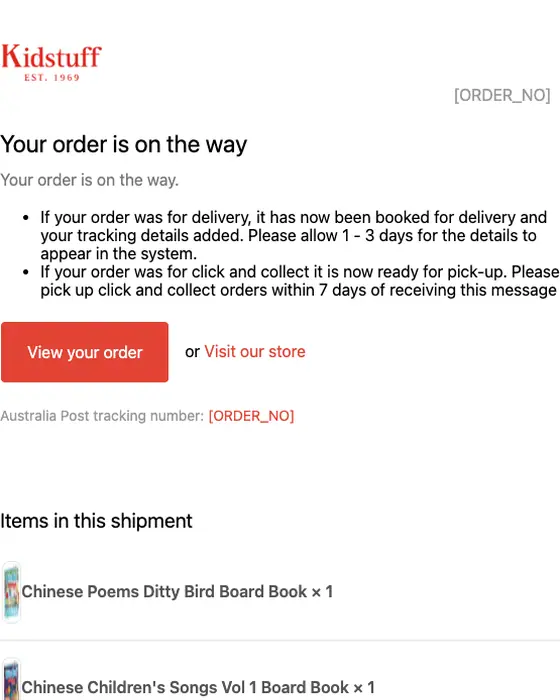
Kidstuff
A shipment from order [REF] is on the way
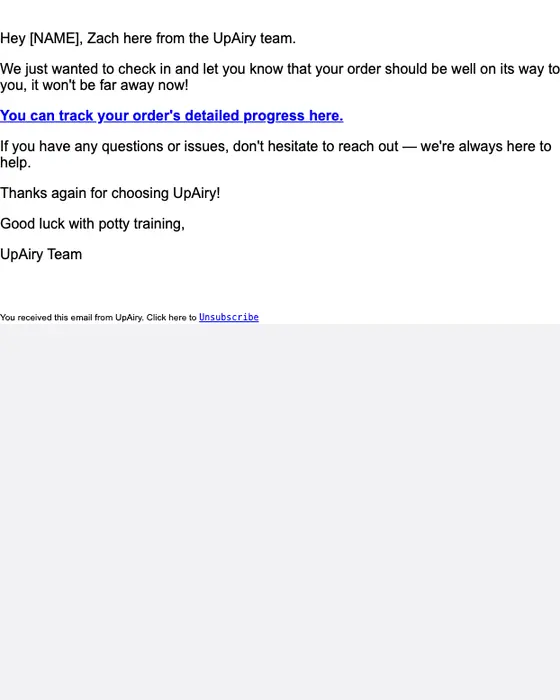
UpAiry
Hey, your order’s shouldn't be far away!
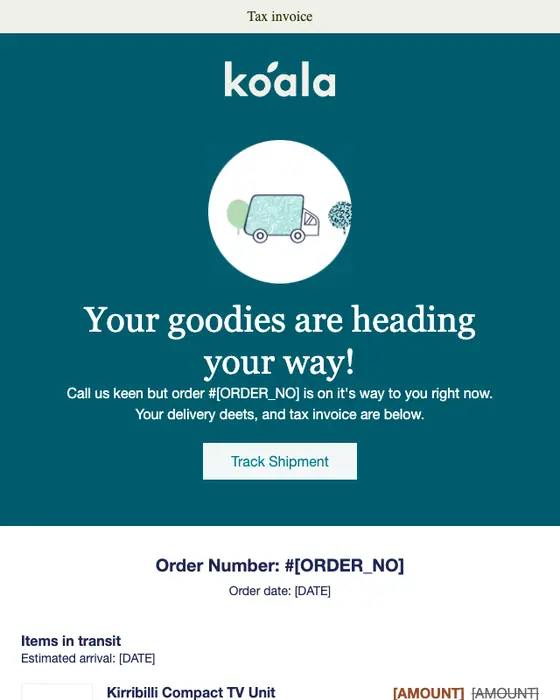
Koala
Your order [ORDER_NO] is on the way
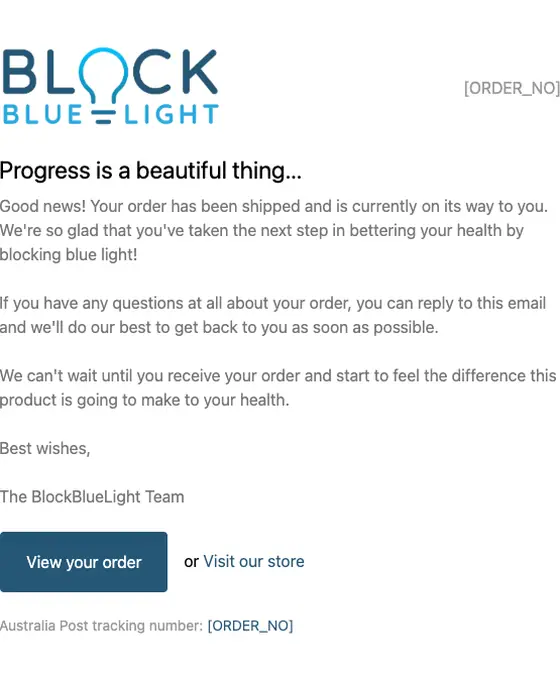
BlockBlueLight AU
A shipment from order [REF] is on the way
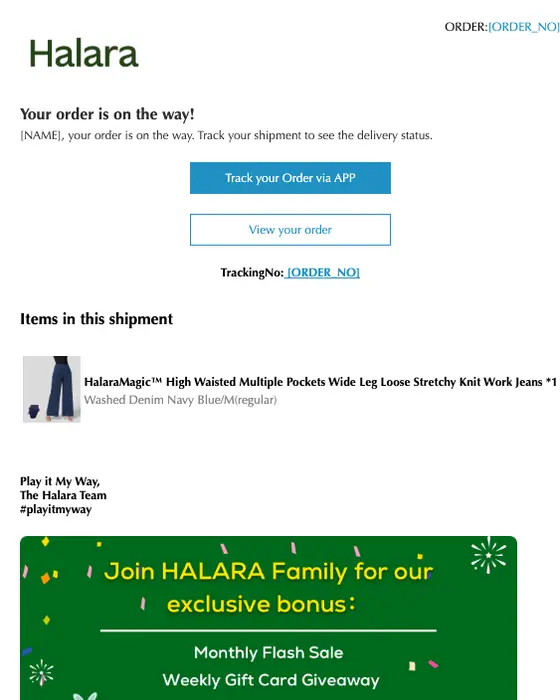
Halara
Your Halara Order is on its way!
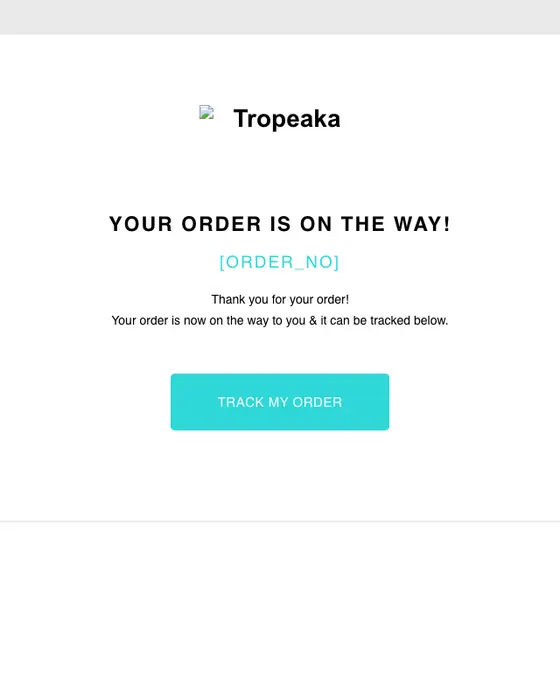
Tropeaka
Your order [REF] is on the way!
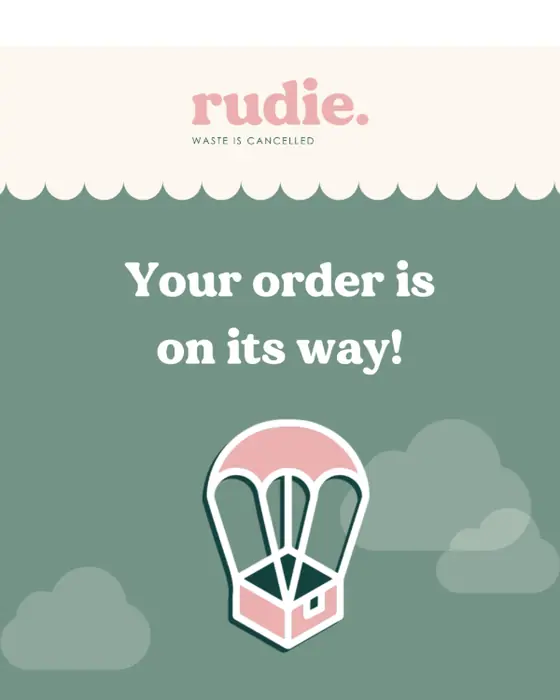
Rudie
Your Period Bestie is on Its Way!💚
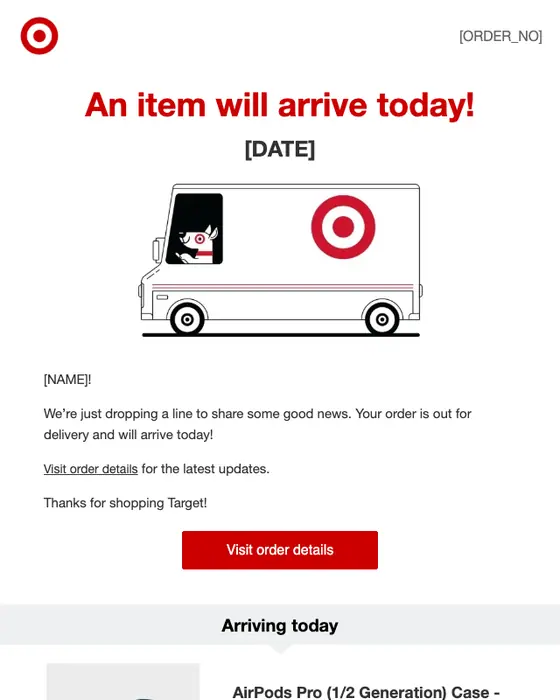
Target
An item arrives today! Order [REF]
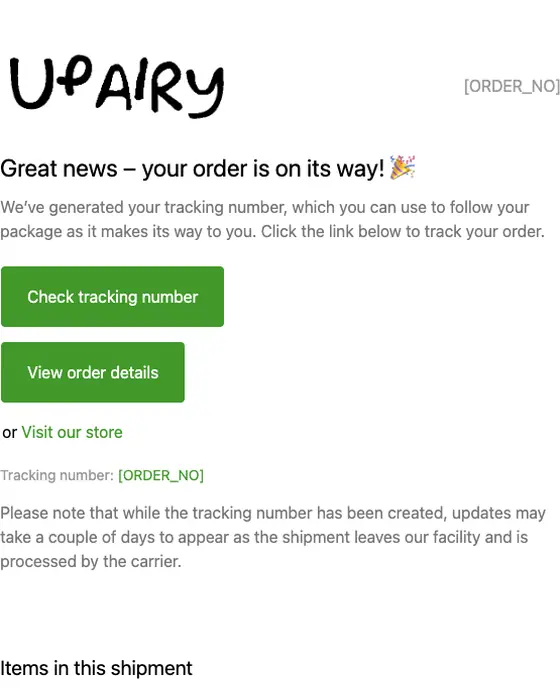
UpAiry
UpAiry order [REF] is prepped and ready to ship!

Bandou
Your order is almost ready to ship...
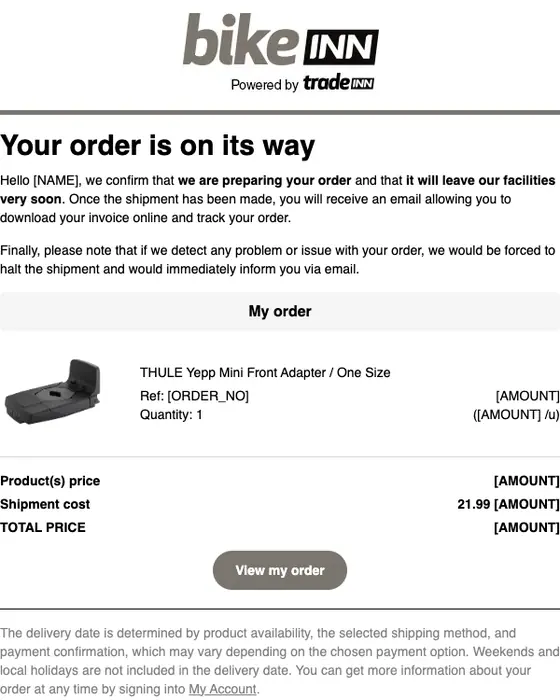
Bikeinn
Your Bikeinn order [REF] is being prepared
70% of the 752 come from Australian senders, so most of the grid is Australian stores and carriers. Three senders account for 44% of the set: Depop with 139, Amazon.com.au with 103 and Australia Post with 91. None of the Depop emails is shown: the subject line names the seller's username in 138 of 139. We also left off emails showing a live tracking number, a receipt barcode or the recipient's ZIP code, and repeats of a template already shown.
How shipping emails differ from order confirmations, same two inboxes
Shipping emails, order confirmations and all email, same two inboxes
752 shipping emails, 471 order confirmations, 12,711 emails| What we measured | Shipping | Order confirmation | All email |
|---|---|---|---|
| Main button or link says track | 60% | 4% | 6% |
| Names a delivery date or window | 29% | 11% | 3% |
| Names the carrier | 35% | 16% | 5% |
| Repeats the order details | 86% | 94% | 20% |
| Greets the reader by first name | 39% | 70% | 40% |
| Asks for one thing only | 36% | 20% | 30% |
| Lays the items out in a table | 6% | 30% | 3% |
| Plain-text layout | 27% | 24% | 32% |
| Monochrome color | 82% | 72% | 62% |
The order confirmation is about what was bought. 70% greet the customer by first name and 30% lay the items out in a table. The shipping email that follows is about the parcel. 60% make tracking the main button or link, against 4% of order confirmations, and only 39% use a first name. 29% name a delivery date or window and 35% name the carrier. 82% are monochrome. The tracking row reads the recorded text label of the main link, so it misses tracking buttons drawn as images: 86 of Australia Post's 91 have an image button, "View tracking and delivery options", and were recorded by their header "VIEW ONLINE" link. The date and carrier rows match words in each email and its image alt text, so a date or carrier shown only as a logo is missed, and the carrier row counts Australia Post naming itself.
Order confirmations have their own collection in order confirmation email examples, and the delivery-day emails that come after are in delivery email examples.
What is in the collected set
By industry
all 752 shipping emails collected| Industry | Emails | Share of the set |
|---|---|---|
| Ecommerce | 359 emails | 48% of the set |
| Marketplace | 159 emails | 21% of the set |
| Couriers and post | 98 emails | 13% of the set |
| Retail and fashion | 57 emails | 8% of the set |
| Home and furniture | 22 emails | 3% of the set |
| Food and beverage | 13 emails | 2% of the set |
Online stores send nearly half. Marketplaces are mostly Depop, whose subject lines name the seller, so none of that row is on the page. The courier row is mostly Australia Post. The 359 from online stores have their own cut in ecommerce shipping email examples.
Next to this one
The same library, cut by the other emails around an order: receipts, tracking updates and emails from couriers and post.
Questions about shipping emails
Lead with the status and the tracking link. Of the 752 shipping emails we collected, 97% use a plain, transactional subject line, 86% repeat the order details, and 60% make tracking the main button or link. Running Warehouse's says the order has shipped, gives one Track Shipment button, then the shipping method and tracking numbers.
Koala AU's 2026 email: "Your order is on the way", a Track Shipment button with the tracking number under it, then the order details, the delivery address and a reminder to be ready on delivery day. It is one of the 60% of our 752 where tracking is the main button. All 19 on this page open full length.
The order confirmation goes out at checkout and is about what was bought: 70% of the 471 we collected greet the customer by first name and 30% lay the items out in a table. The shipping confirmation is about the parcel: 70% of our 752 are short or very short, and 60% make tracking the main button or link.
Only 39 of the 752 are published as images in this library so far, and we took 20 of those off this page. Eleven could identify a person (a live tracking number, a ZIP code or a Depop seller's username). Four were not shipping notices, Four repeated a template already shown and one did not render. The percentages describe all 752.
Send one like it
Simple pricing. Unlimited contacts.
Every plan includes full stack emailing: Flows, Newsletter Campaigns and Transactional Email, plus our NitroWheel LLM and all agent integrations (Claude, ChatGPT, Codex, Cursor and others). Pay for what you send, not who you store.
- Emails 8,000then 500/mo
- Email types Transactional & Marketing
- AI actions 20/mo
- Contacts Free & Unlimited
- Brands 3 · Custom domain 1
- Seats 1
- Recipients / rolling 24h 100–5,000
- Email validation Prepaid only
- Emails 20,000/month
- NitroWheel LLM Included
- Brands 5 · Domains 3
- AI actions 1,000/mo
- Contacts Free & Unlimited
- BYO sending and AI keys Yes
- Seats 3
- Recipients / rolling 24h 1,000–100,000
- Email validation Prepaid only
- Emails 125,000/month
- AI actions 5,000/mo
- Brands 10 · Domains 10
- Seats 10
- Frontier AI Included
- Dedicated IP Available
- Recipients / rolling 24h 1,000–625,000
- Email validation Prepaid only
- AI actions Unlimited
- Unlimited brands & domains Included
- SSO / SAML Included
- 99.9% SLA Included
- Recipients / rolling 24h Contracted
- Email validation Prepaid only
Daily allowances depend on your plan and sender standing. Strong list, domain and delivery evidence can raise standing, including on day one. Trusted receives the full plan allowance; available email credits, safety checks and delivery pacing still apply.
Free forever. No credit card required. See full comparison →