
What a logistics email is
A logistics email is sent by the carrier, courier or freight company moving a parcel, not by the store that sold it: a tracking update, a delivery notice, a pickup confirmation, or a survey after the parcel arrives.
We collected 266 emails tagged logistics, from 25 brands, in two real inboxes, sent between 2016 and 2026, and show 4 of them here. Australia Post sent 222 of the 266, so the percentages below describe all 266 but mostly one Australian carrier.
Browse the 4 logistics emails
Open any email to see it full length, with its subject line, notes on what it is doing, and a prompt that rebuilds it.
Australia Post
Your parcel from WH Clayton is on its way
Aramex
Your parcel is on its way
Australia Post
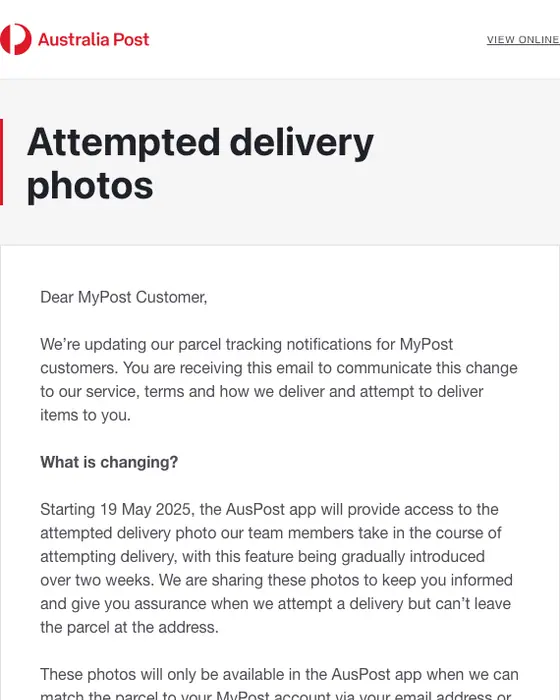
Update to our parcel tracking notifications
BRT
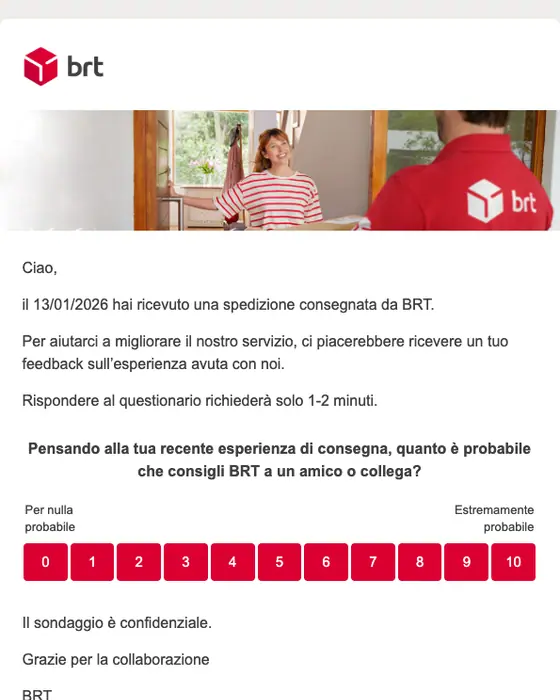
Quanto sei soddisfatto della consegna del 13/01/2026?
How a carrier's parcel update differs from the store's
Carrier against store: delivery, shipping and tracking emails
242 from 13 logistics brands, 896 from 272 other brands| What we measured | Sent by the carrier | Sent by the store |
|---|---|---|
| Greets the reader by first name | 2% | 44% |
| Utilitarian design | 98% | 45% |
| Text heavy | 88% | 63% |
| Medium length | 88% | 16% |
| Instructional tone | 63% | 13% |
| Monochrome color | 92% | 80% |
The same parcel update reads differently depending on who sends it. 44% of the delivery, shipping and tracking emails a store sent itself greet the reader by first name; 2% of the carrier's do. Carrier emails are also more uniform: 98% use a utilitarian design and 88% run to medium length, against 45% and 16%. One sender dominates each side: Australia Post sent 220 of the 242 carrier emails, and a single marketplace 232 of the 896 store emails. For the store that sold the parcel, that makes the carrier's update wasted space: the reader gets a plain, mostly monochrome carrier template (92% of the 242) instead of the store's own design.
What is in the collected set
By email type
all 266 collected| Type | Emails | Share |
|---|---|---|
| Delivery notice | 114 | 43% |
| Shipping update | 98 | 37% |
| Tracking update | 30 | 11% |
| Marketing: promotion, newsletter or discount | 14 | 5% |
| Everything else: surveys, account notices, receipts and others | 10 | 4% |
Few of these are marketing. 14 of the 266 are a promotion, newsletter or discount, and 3 of those were sent to a business rather than a consumer. For the shipper-facing side, such as rate updates and outreach to new accounts, see email marketing for lead generation.
Next to this one
The same parcel emails, cut by type, and the stores that send their own:
Questions about the collection
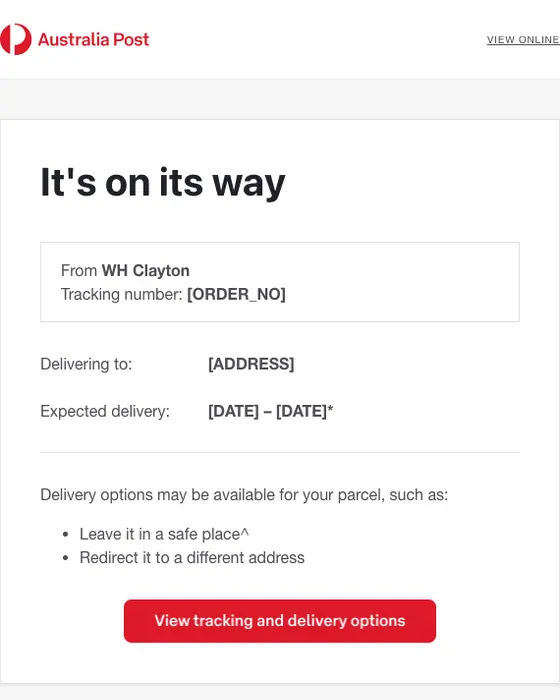
Australia Post's tracking email is typical. The headline says "It's on its way", a box gives the sender and tracking number, then come the delivery address, an expected delivery window, two delivery options and one red "View tracking and delivery options" button. 98% of the 242 carrier delivery, shipping and tracking emails we collected use a plain, utilitarian design.
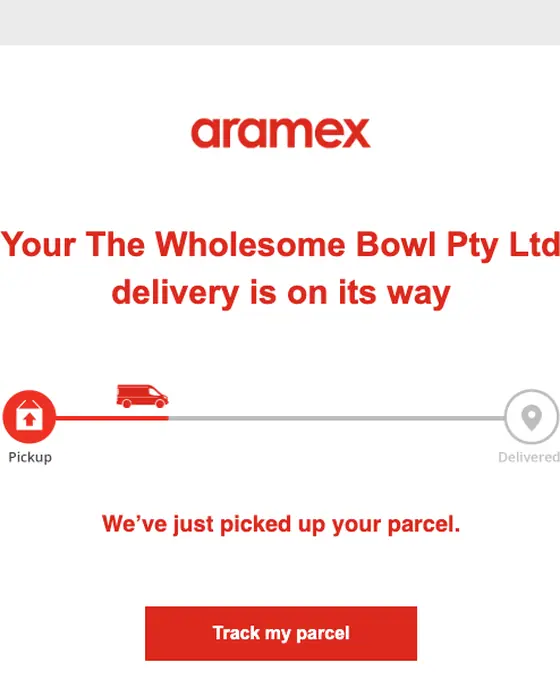
Aramex's, from 2026, opens with a red headline naming the store that sent the parcel, a progress line from Pickup to Delivered, "We've just picked up your parcel." and a "Track my parcel" button, then the label number and a note on where the parcel will be left. Shipping updates are 98 of the 266 logistics emails we collected.
Not on this page. Only 14 of the 266 emails tagged logistics (5%) are marketing sends, a promotion, newsletter or discount from 6 brands, and none of them is shown here. For marketing to shippers, our B2B email marketing best practices cover it.
Rarely. 8 of the 266 logistics emails we collected greet the reader by first name, 3%. When a store sends its own delivery, shipping or tracking email, 44% of the 896 we collected do. Carriers lead with the parcel instead: Australia Post's tracking email opens with "It's on its way" and the name of the sender, not the reader.
26 of the 266 were rendered full length. We removed three broken renders, thirteen that showed personal details (an address, a ZIP code, a name or a phone number), four repeats of one Australia Post template and two car-park emails that are not logistics. That leaves 4 from 3 brands. The rest count in the percentages but are not shown.