
![Airbnb booking confirmation email: Confirmed: Your reservation for [DATE], 14](/email-examples/img/1993274583b582dd-t.webp)
![Koala AU shipping email: A shipment from order [REF] is on the way](/email-examples/img/19b7a5518d0d67e6-t.webp)
![Kitchen Warehouse delivery email: Your order [REF] has been delivered](/email-examples/img/19dfbcf55dc86320-t.webp)
![Vercel Inc. receipt email: Your receipt from Vercel Inc. #[ORDER_NO]](/email-examples/img/19f0ab8701117cbe-t.webp)
What a fulfillment email is
A fulfillment email is the message a customer gets after they pay: the order confirmation, the shipping confirmation, the delivery notice, the receipt, the booking confirmation. Marketers also call these post purchase emails. Their job is to say what was bought and what happens next.
We collected 3,208 fulfillment emails from 876 brands out of two ordinary inboxes, sent between 2016 and 2026, 3,140 of them in 2023 or later. Nothing here is a mockup. 74% come from Australian senders and 9% from American ones, because the inboxes are Australian. 364 have been published as images so far, and this page shows 145 from 129 brands. We left off 219: 162 that show personal details (a ZIP code beside a redacted address, a seller's username, a doctor's name, a license plate) or did not render properly, 46 repeats of a template the same brand already has here, and 11 that are not about an order, such as review requests and race-week countdowns.
Browse all 145 fulfillment emails
Tap a type to narrow the grid: 26 order confirmations, 20 booking confirmations, 17 shipping updates, 14 receipts and 11 delivery notices, plus payment confirmations, invoices, refunds and cancellations under More filters. Open any email to see it full length, with its subject line, notes on what it is doing, and a prompt that rebuilds it.
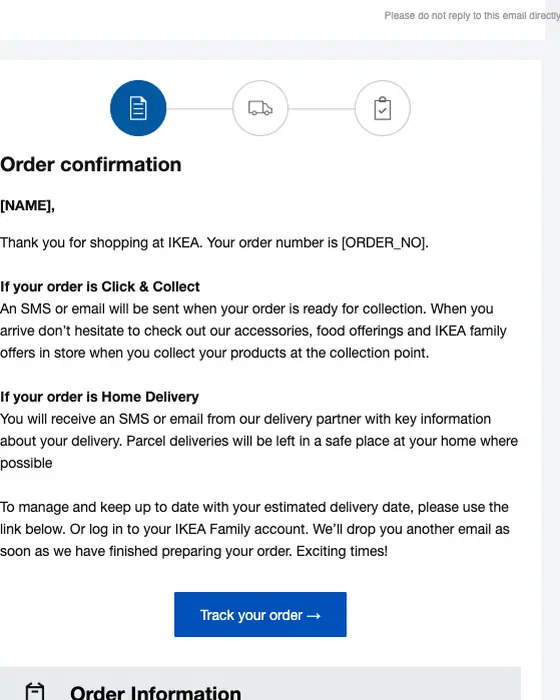
IKEA
Order confirmation
Koala AU
A shipment from order [REF] is on the way
Kitchen Warehouse
Your order [REF] has been delivered
Vercel Inc.
Your receipt from Vercel Inc. #[ORDER_NO]
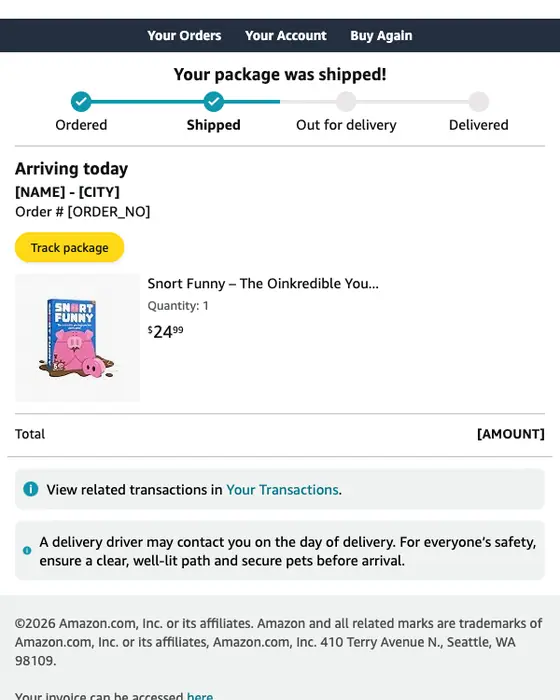
Amazon.com
Shipped: "Snort Funny – The..."
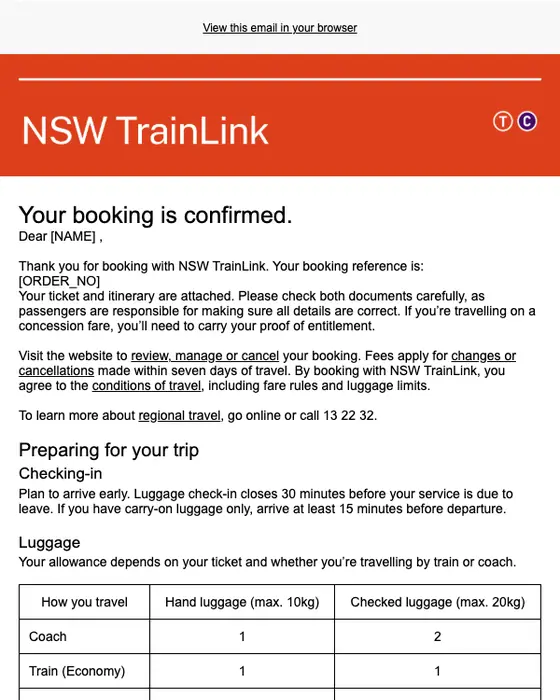
NSW TrainLink
NSW TrainLink - Purchase Confirmed for Booking [ORDER_NO]
Airbnb
Confirmed: Your reservation for [DATE] – 14
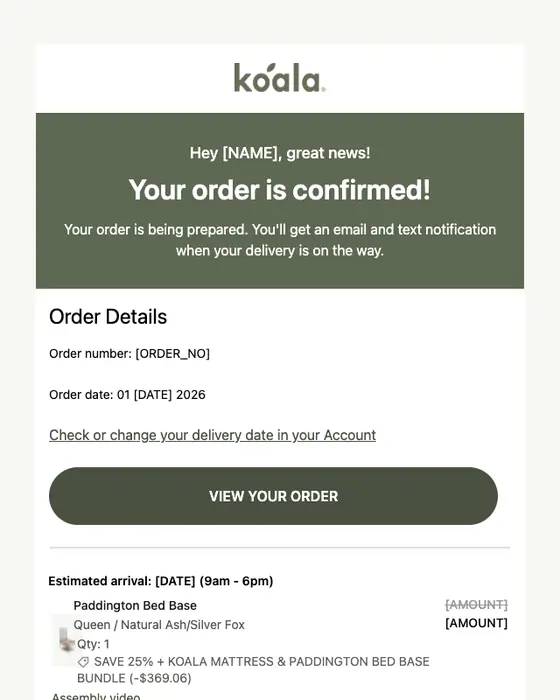
Koala AU
Order [REF] confirmed
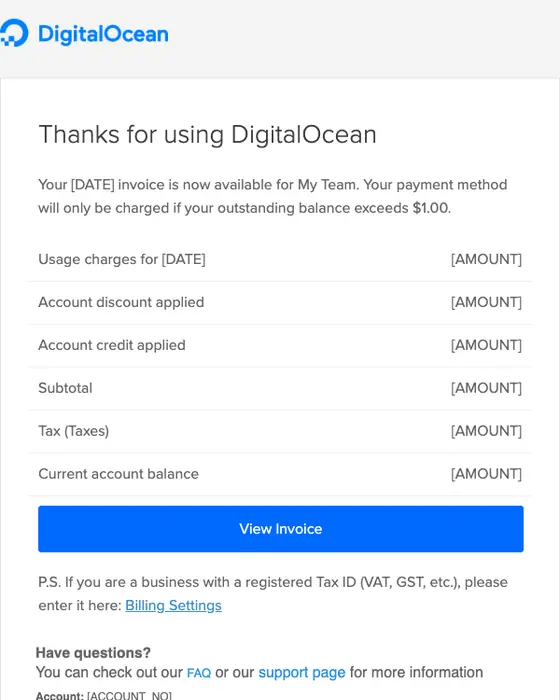
DigitalOcean
[DigitalOcean] Your [DATE] invoice is available
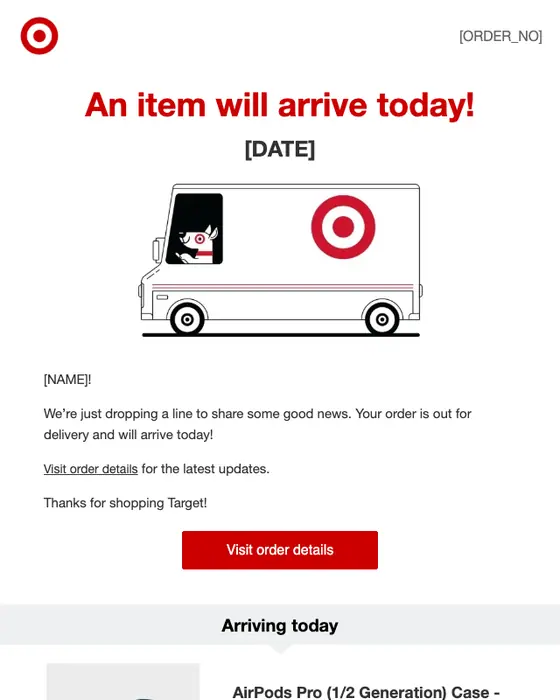
Target
An item arrives today! Order [REF]
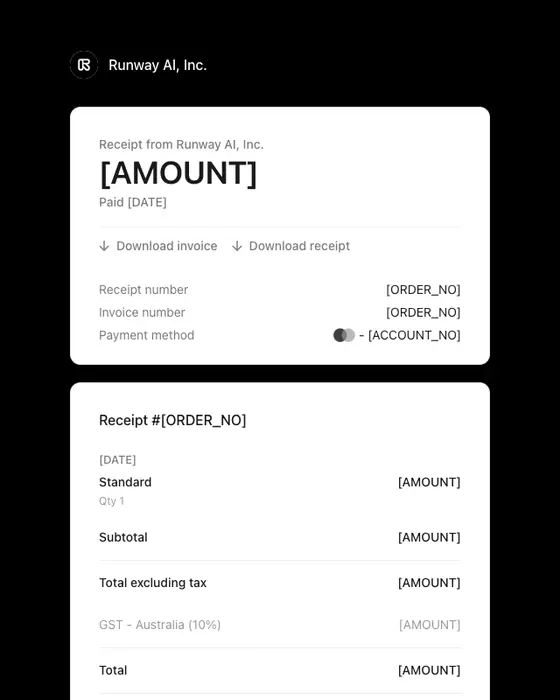
Runway AI, Inc.
Your receipt from Runway AI, Inc. #[ORDER_NO]
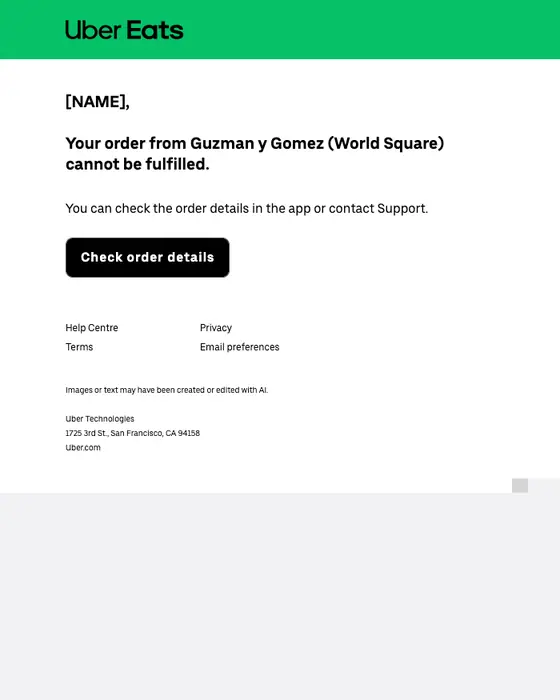
Uber Eats
Your order from Guzman y Gomez (World Square) cannot be fulfilled
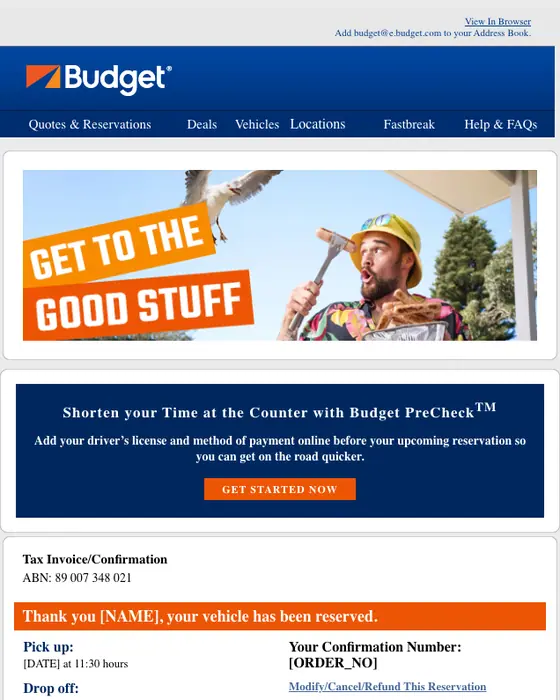
Budget
Budget Rent A Car: Reservation Confirmation: [NAME], your Budget reservation #[ORDER_NO] at CNS is confirmed
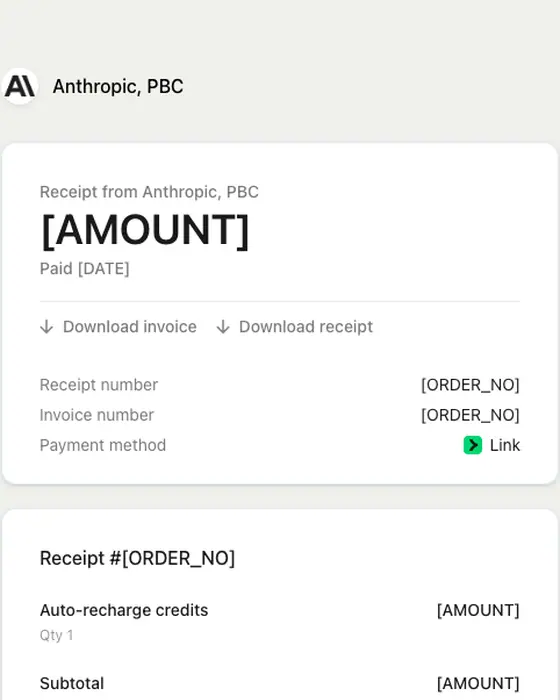
Anthropic, PBC
Your receipt from Anthropic, PBC #[ORDER_NO]
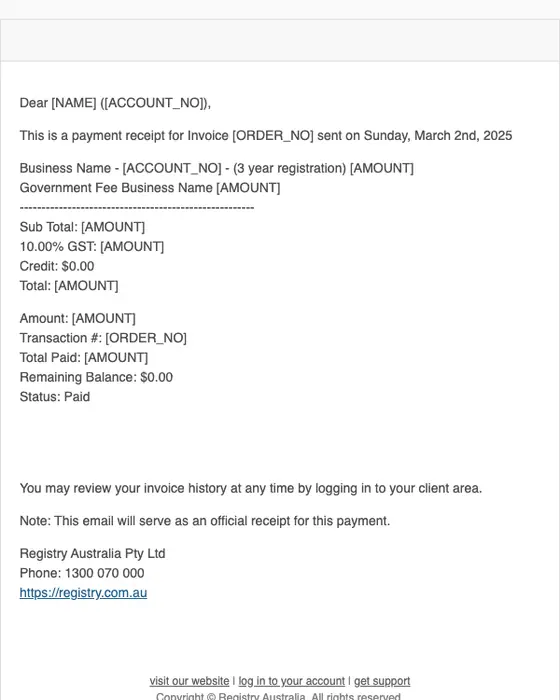
Registry Australia
Invoice Payment Confirmation
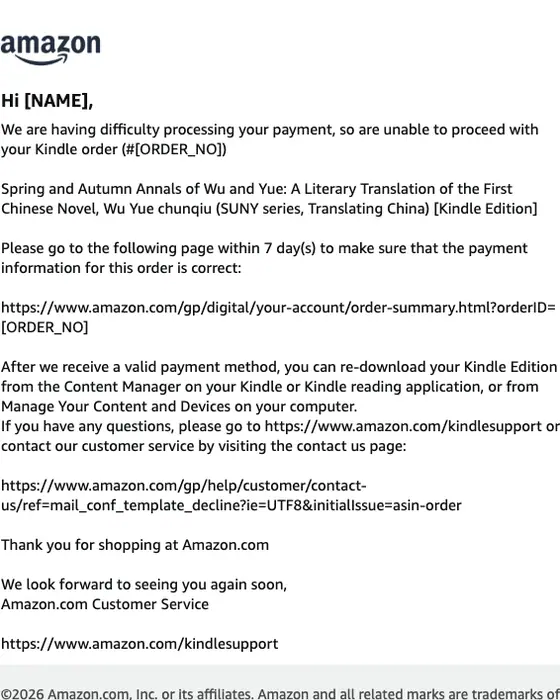
Amazon.com
Action Required: Problem with Your Kindle Order #[ORDER_NO]
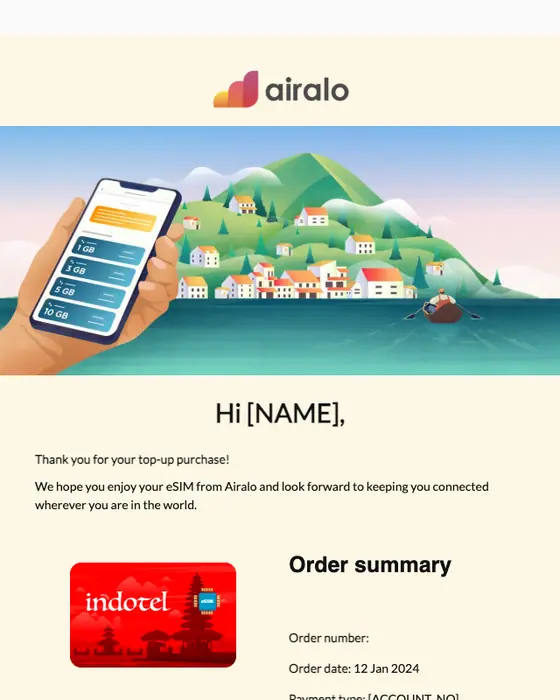
Airalo
Thank you for your top-up order!
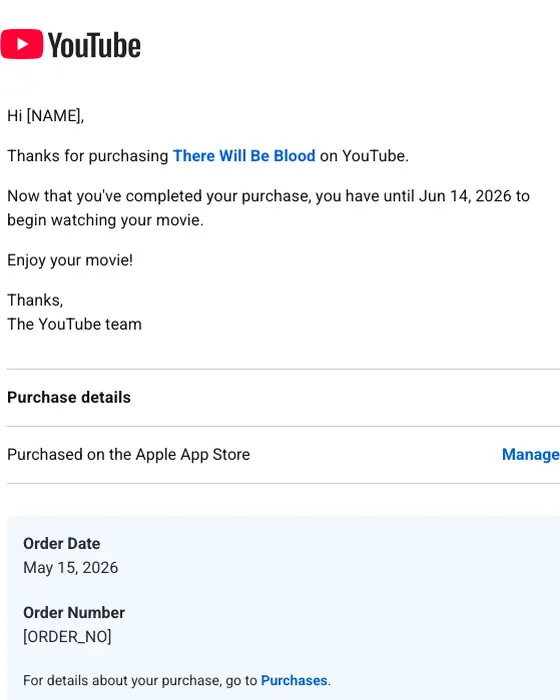
YouTube
Your YouTube receipt
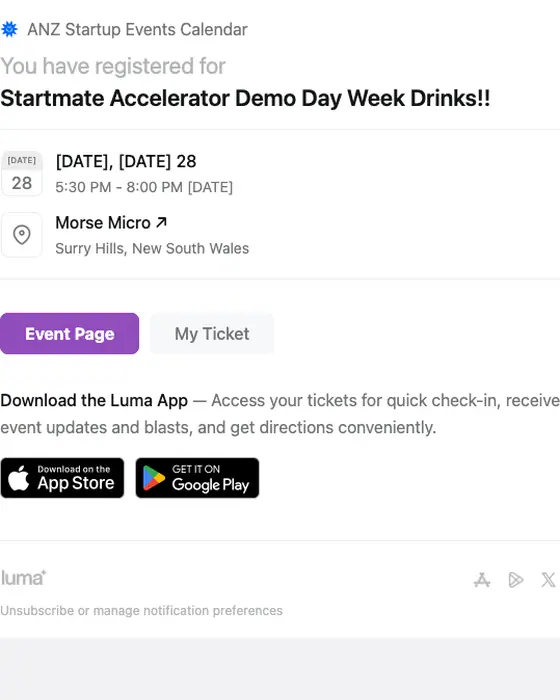
ANZ Startup Events Calendar
Registration confirmed for Startmate Accelerator Demo Day Week Drinks!!
TodayTix
Hey [NAME], your order for Potted Potter is confirmed
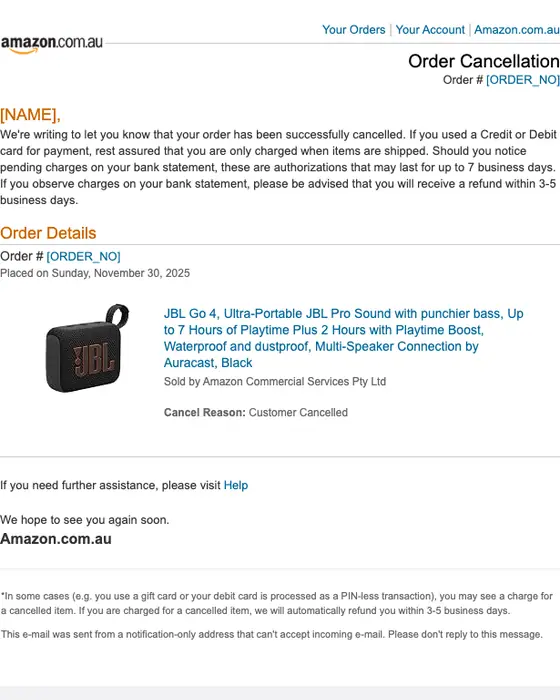
Amazon.com.au
Your order has been cancelled.
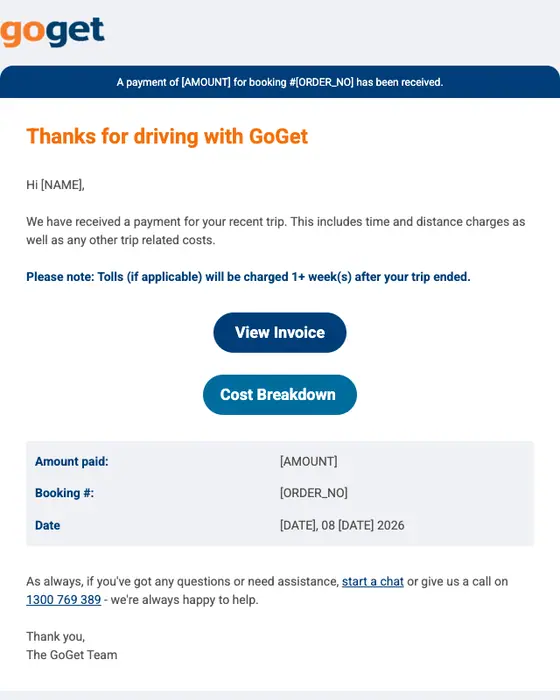
GoGet
Payment for booking #[ORDER_NO] was received
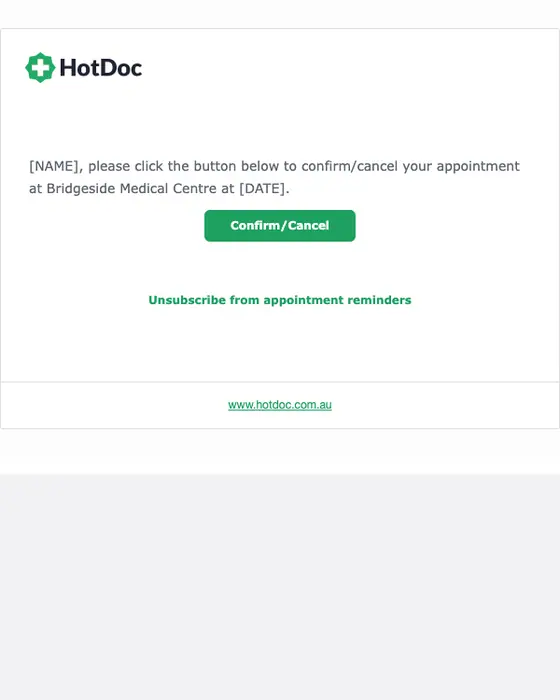
Bridgeside Medical Centre
[NAME], please confirm your upcoming appointment at Bridgeside Medical Centre
How fulfillment emails differ from other email
Fulfillment emails and all email, same two inboxes
3,208 fulfillment emails, 12,711 emails| What we measured | Fulfillment | All email |
|---|---|---|
| Subject line states the transaction plainly | 94% | 33% |
| Neutral in tone | 61% | 27% |
| Text heavy | 71% | 60% |
| Greets the reader by first name | 58% | 40% |
| Has a data table (items, prices, times) | 10% | 3% |
| Plain-text layout | 39% | 32% |
| Has a button | 27% | 40% |
| Asks for one thing only | 25% | 30% |
| Has a hero image | under 1% | 12% |
| Median calls to action | 2 | 2 |
Fulfillment email is plainer than email in general. 94% of subject lines just state the transaction ("Order confirmation", "Your parcel is on its way"), against 33% of all email, and only 1 of the 3,208 leads with a discount. 61% are neutral in tone, more than twice the rate of email overall, and half (50%) use a utilitarian design.
It is also more personal. 58% greet the reader by first name, against 40% of all email, and 10% carry a data table of items, prices or times, more than three times the overall rate. What it rarely does is decorate: 30 emails out of 3,208 open with a hero image.
Just over a quarter (27%) include a button, against 40% of all email, and a quarter ask for one thing only, against 30%.
Taken together, the numbers describe a default template: 94% keep the subject line plain and under 1% open with a hero image. The reader is waiting for this email, and most senders spend none of that attention on anything beyond the order details.
What the set looks like
By type of email
all 3,208 fulfillment emails collected| Type | Emails | Share of the set | Greets by first name | Has a data table | Ask for one thing |
|---|---|---|---|---|---|
| Shipping | 752 | 23% | 39% | 6% | 36% |
| Order confirmation | 470 | 15% | 70% | 30% | 20% |
| Receipt | 463 | 14% | 66% | 14% | 17% |
| Delivery | 345 | 11% | 29% | 4% | 16% |
| Booking confirmation | 303 | 9% | 60% | 7% | 15% |
| Invoice | 196 | 6% | 70% | 11% | 33% |
| Appointment | 174 | 5% | 97% | 0% | 32% |
| Everything else (account notices, reservations, cancellations, refunds) | 505 | 16% | 70% | 3% | 30% |
Each type behaves differently. Of the seven types above, shipping updates are the most focused (36% ask for one thing only), and only 39% use the reader's first name. Order confirmations and receipts are the opposite: about two thirds greet by first name, and order confirmations are the type most likely to lay the order out as a table (30%). Appointment confirmations almost all use the first name (97%) and none carry a table.
IKEA order confirmation
Two short paragraphs on what happens next, one for Click and Collect and one for home delivery, then a "Track your order" button, the delivery and billing details, and every item with its article number.
Koala AU shipping confirmation
The subject line reads "A shipment from order [REF] is on the way". Inside, a Track shipment button and the tracking number come first, then the items, then the delivery address.
Kitchen Warehouse delivery notice
Confirms the order arrived, explains that an order can arrive in more than one package, and ends with a five-star rating for the delivery.
Airbnb booking confirmation
Check-in and checkout times come first, then the address, the guest count, house rules, safety notes, the cancellation policy and the payment, each in its own headed block.
By industry
the eight largest, of 3,208 fulfillment emails| Industry | Emails | Share of the set |
|---|---|---|
| Ecommerce | 775 | 24% |
| Marketplaces | 336 | 10% |
| Logistics and couriers | 245 | 8% |
| Travel | 241 | 8% |
| Retail and fashion | 168 | 5% |
| Fintech | 167 | 5% |
| Food and drink | 161 | 5% |
| SaaS | 156 | 5% |
Next to this one
Each type has its own page, from every stage of the library: order confirmations, shipping emails, delivery emails, receipts, booking confirmations and invoices. The stages either side of this one are onboarding and retention.
Questions about fulfillment emails
It is the email a customer gets after paying, telling them what happens to their order or booking: confirmed, shipped, delivered, receipted or booked in. Shipping updates are the biggest group in the 3,208 we collected (23%), then order confirmations (15%) and receipts (14%).
Five things: the order number and, once it ships, the tracking number; the items bought; the delivery address; when it should arrive; and how to reach support. Most of the 3,208 we collected say it plainly: 94% have a subject line that just names the transaction, and 30% of order confirmations lay the items out in a table.
Almost never. 30 of the 3,208 we collected open with a hero image, under 1%, against 12% of all email in the same inboxes. 71% are text heavy.
364 of the 3,208 have been published as images in this library so far, and we took 219 of those off this page: 162 that show personal details or did not render properly, 46 repeats of a template the same brand already has here, and 11 that are not about an order. The percentages on this page still describe all 3,208.
Send one like it
Simple pricing. Unlimited contacts.
Every plan includes full stack emailing: Flows, Newsletter Campaigns and Transactional Email, plus our NitroWheel LLM and all agent integrations (Claude, ChatGPT, Codex, Cursor and others). Pay for what you send, not who you store.
- Emails 8,000then 500/mo
- Email types Transactional & Marketing
- AI actions 20/mo
- Contacts Free & Unlimited
- Brands 3 · Custom domain 1
- Seats 1
- Recipients / rolling 24h 100–5,000
- Email validation Prepaid only
- Emails 20,000/month
- NitroWheel LLM Included
- Brands 5 · Domains 3
- AI actions 1,000/mo
- Contacts Free & Unlimited
- BYO sending and AI keys Yes
- Seats 3
- Recipients / rolling 24h 1,000–100,000
- Email validation Prepaid only
- Emails 125,000/month
- AI actions 5,000/mo
- Brands 10 · Domains 10
- Seats 10
- Frontier AI Included
- Dedicated IP Available
- Recipients / rolling 24h 1,000–625,000
- Email validation Prepaid only
- AI actions Unlimited
- Unlimited brands & domains Included
- SSO / SAML Included
- 99.9% SLA Included
- Recipients / rolling 24h Contracted
- Email validation Prepaid only
Daily allowances depend on your plan and sender standing. Strong list, domain and delivery evidence can raise standing, including on day one. Trusted receives the full plan allowance; available email credits, safety checks and delivery pacing still apply.
Free forever. No credit card required. See full comparison →