
![Cerebral Palsy Alliance promotional email: [NAME], your gift can be doubled right now.](/email-examples/img/19eb42dc28518237-t.webp)
What a nonprofit email is
A nonprofit email is a message a charity, foundation or advocacy group sends to its supporters: welcomes, fundraising appeals, donation receipts and thank-yous, newsletters about the work, and invitations to events and fundraisers.
We collected 152 emails from 76 nonprofit senders in two ordinary inboxes, sent between 2016 and 2026, and show 35 of them here. 14 are held back for privacy or a broken render, so the numbers below describe the other 138 emails, from 72 senders. 65 of those emails are Australian and 60 American. We left out repeat sends of the same template, emails from groups a reader would not count as a nonprofit, and walls of text. Want the one to copy? Jump to a real example of each type.
Browse 35 nonprofit emails
Filter by type, or search a sender or subject line. Open any email to see it full length, with its subject line, notes on what it is doing, and a prompt that rebuilds it as a template.
Nonprofit email types, with a real one each
Five emails a nonprofit sends, in the order a new supporter meets them.
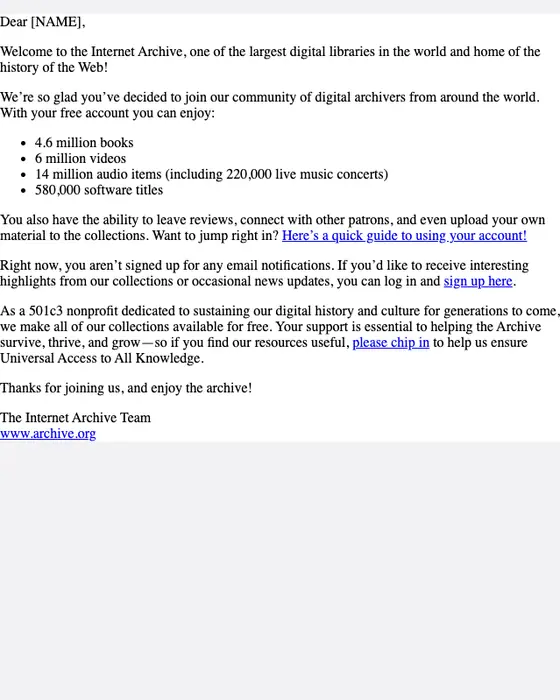
Internet Archive welcome email
Subject: “Welcome to the Internet Archive” (2025). Plain text, no images. It lists what a free account opens up (4.6 million books, 6 million videos, 14 million audio items, 580,000 software titles), links a quick guide to the account, and only near the end says the Archive is a nonprofit and asks you to chip in.
More welcome emails in the full library.
Cerebral Palsy Alliance fundraising appeal
Subject: “[NAME], your gift can be doubled right now.” (2026). A matched-giving day: every gift is doubled up to a cap, and matching stops when the cap is reached. One ask, repeated: the same green "Double my gift now" button appears three times, with three suggested amounts, then the story of one baby the money helps.
Also here: Kiva, Zoos Victoria and PetRescue. More appeals and promotional emails in the full library.
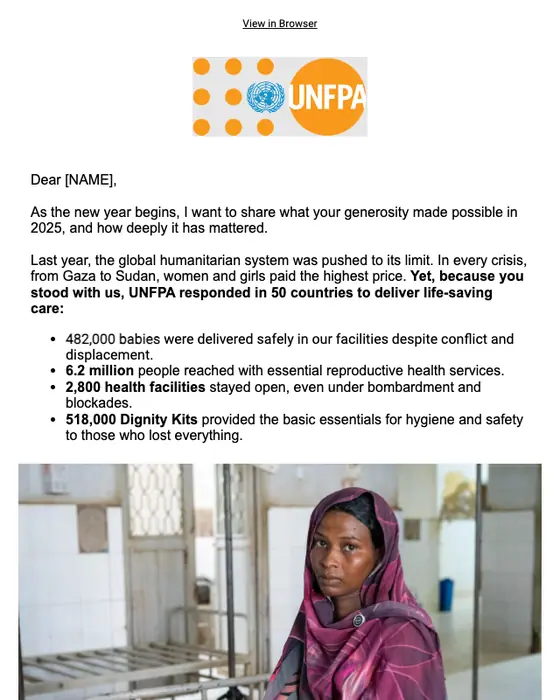
UNFPA thank-you and impact report
Subject: “Your 2025 impact: 6.2M reached and 482,000 safe births” (2026). Thanks the donor with four numbers from the year (482,000 safe births, 6.2 million people reached, 2,800 health facilities kept open, 518,000 dignity kits), one photo, and a red button to keep giving.
Also here: Fair Fight. More thank-you emails in the full library.
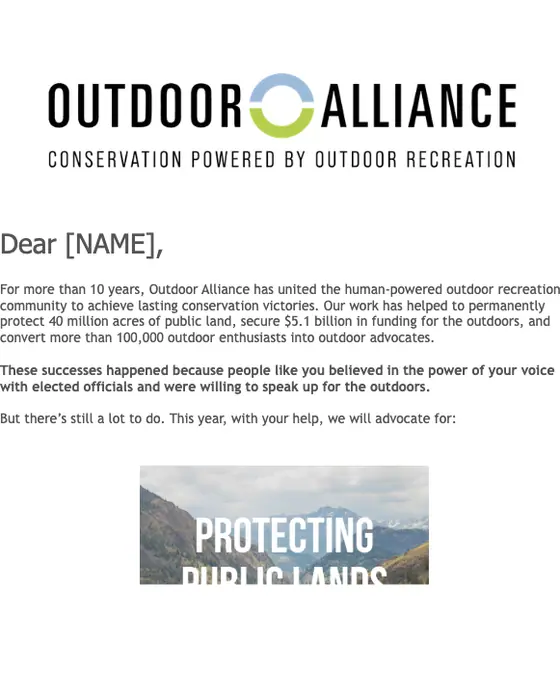
Outdoor Alliance newsletter
Subject: “Four ways to make a difference for the outdoors today” (2025). Opens with the record (40 million acres protected, $5.1 billion in funding), then gives each issue it will fight for an image tile, so the newsletter reads as a list of causes to back.
Also here: UNICEF Australia, Wikimedia Foundation and NutritionFacts.org. More newsletters in the full library.
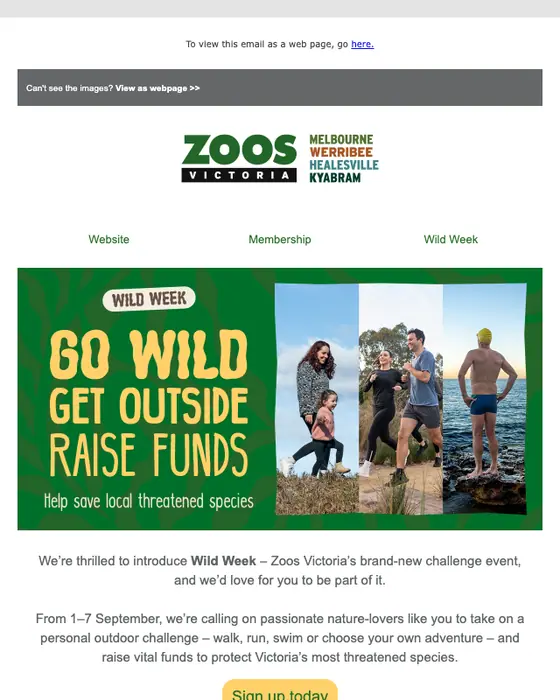
Zoos Victoria event invite
Subject: “Wild Week is coming! 👀” (2025). An invitation that is also a fundraiser: a one-week walk, run or swim challenge, with the same "Sign up today" button above and below a short video.
Also here: Thoughtful Foods and Pay It Forward. More event invites in the full library.
How nonprofit email differs from everything else
Nonprofit email against every other email
138 nonprofit emails and 12,154 other emails, from the same two inboxes| What we measured | Nonprofit | Everything else |
|---|---|---|
| Promotional email and appeals | 33% | 22% |
| Newsletters | 20% | 12% |
| Event invites and webinars | 15% | 6% |
| Thank-yous and donation receipts | 13% | 4% |
| Advocacy stage: supporters asked to act or spread the word | 22% | 1% |
| Urgent tone | 35% | 12% |
| Warm tone | 30% | 15% |
| Greets the reader by first name | 54% | 39% |
| Long | 30% | 16% |
| Text heavy | 72% | 61% |
| Plain-text layout | 38% | 32% |
| Exactly one call to action | 19% | 31% |
| Median calls to action | 2.5 | 2 |
Nonprofit email is written to move people. 35% of it is urgent in tone and 30% is warm, against 12% and 15% of other email, and 22% sits at the advocacy stage, asking supporters to take action or spread the word, where almost no other sender goes (1%). It runs longer too: 30% is long, against 16%.
It also asks for more at once. The median nonprofit email carries 2.5 calls to action, against 2, and only 19% has exactly one, against 31% of other email. Thank-yous and donation receipts make up 13% of what nonprofits send, three times the share elsewhere (4%).
What is in the collected set
By type
the 138 nonprofit emails we count| Type | Emails | Share of the set |
|---|---|---|
| Promotional and appeals | 45 emails | 33% of the set |
| Newsletter | 27 emails | 20% of the set |
| Event invite | 17 emails | 12% of the set |
| Donation receipt | 11 emails | 8% of the set |
| Re-engagement | 8 emails | 6% of the set |
| Thank-you | 7 emails | 5% of the set |
| Welcome | 5 emails | 4% of the set |
| Webinar | 4 emails | 3% of the set |
| 8 other types | 14 emails | 10% of the set |
The grid shows 35 emails from 29 senders, 19 of them Australian and 26 sent in 2023 or later. It shows 11 promotional emails and appeals, 11 newsletters and 4 event invites and webinars. 4 of the 35 use a plain-text layout, against 38% of the 138 collected: plain text is common in this sector, but most of it reads as a wall on a phone, so we show a handful. Only 66 of the 152 have been rendered for the library so far.
Next to this one
The same library, cut a different way: government emails, education emails and healthcare emails by industry, or by the job the email does: welcome emails, thank-you emails, receipts, newsletters, event invites and re-engagement emails.
Questions about nonprofit email
The one that thanks. Thank-yous and donation receipts are 13% of the 138 nonprofit emails we collected, three times the share in other email, and the strongest ones report what the gift did. The UNFPA example on this page leads with four numbers from the year, and one photo, before it asks again.
In our set, promotional emails and fundraising appeals lead at 33% of the 138, then newsletters at 20%, event invites at 12%, donation receipts at 8%, re-engagement emails at 6% and thank-yous at 5%. Welcomes are 4% and webinars 3%. Together the top eight types cover 90% of what we saw.
Cerebral Palsy Alliance's giving-day appeal: every gift doubled until the cap is reached, one ask repeated on three green buttons, three suggested amounts, then one child's story. It shows how to repeat a single ask instead of adding new ones. The median nonprofit email we collected carries 2.5 calls to action, against 2 elsewhere.
66 of the 152 have been rendered full length for the library so far. We took 31 off this page: ten for privacy or a broken render, plus repeat sends, senders that are not nonprofits, two emails not in English, and walls of text. Four more were removed library-wide for privacy. The rest are not rendered yet.